Drlogy
Healthcare organization
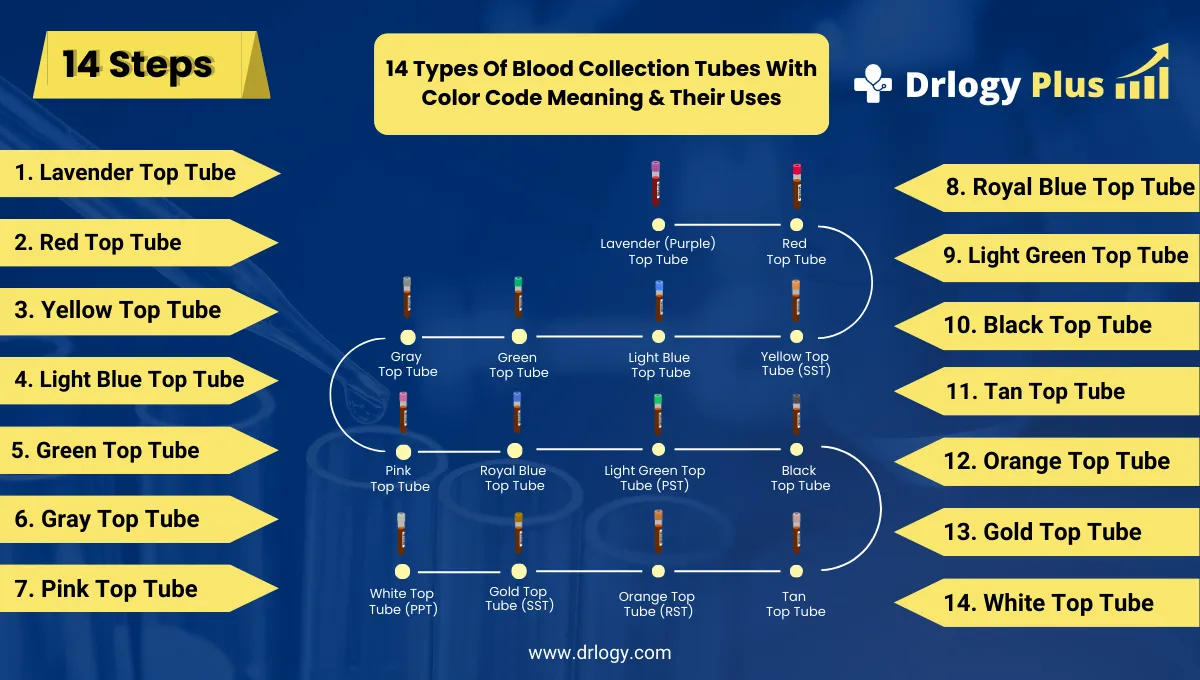
14 Types of Blood Collection Tubes with Color Code Meaning & Their Uses
Blood collection tubes are essential for accurate diagnostic testing.
Check
Each tube is color-coded based on its additive, which either prevents clotting, promotes clotting, or preserves a specific analyte. Choosing the correct tube ensures reliable lab results and prevents sample rejection.
Types of Blood Collection Tubes
| Name | Additive | Use |
|---|---|---|
| Lavender (Purple) Top Tube | EDTA (Ethylenediaminetetraacetic acid) | Complete blood count (CBC), blood smears, blood bank |
| Red Top Tube | None (plain) | Serum chemistry tests, blood bank, serology |
| Yellow Top Tube (SST) | Clot activator and gel for serum separation | Serum chemistry tests, serology |
| Light Blue Top Tube | Sodium citrate | Coagulation studies (e.g., PT, aPTT) |
| Green Top Tube | Sodium heparin or lithium heparin | Plasma chemistry tests, cytogenetics |
| Gray Top Tube | Potassium oxalate and sodium fluoride | Glucose testing, blood alcohol levels, lactate |
| Pink Top Tube | EDTA | Blood bank, crossmatching |
| Royal Blue Top Tube | Either EDTA or none (trace element-free) | Trace element studies, toxicology, nutritional chemistry |
| Light Green Top Tube (PST) | Lithium heparin and gel for plasma separation | Plasma chemistry tests |
| Black Top Tube | Sodium citrate (higher concentration) | Erythrocyte sedimentation rate (ESR) |
| Tan Top Tube | EDTA | Lead testing |
| Orange Top Tube (RST) | Thrombin-based clot activator | STAT serum chemistry tests |
| Gold Top Tube (SST) | Clot activator and gel for serum separation | Serum chemistry tests, serology |
| White Top Tube (PPT) | EDTA and gel for plasma separation | Molecular diagnostics, PCR tests |
14 Types of Blood Collection Tubes with Color Code Meaning & Uses
Below are the 14 common blood collection tubes with color code and meaning.
1. Lavender (Purple) Top Tube
- Contains EDTA which prevents blood clotting by binding calcium.
- Commonly used for hematology tests like CBC, ESR, and blood smears.
- Maintains cell morphology for accurate microscopic examination.
- Ideal for blood grouping and crossmatching procedures.
- Provides whole blood or plasma samples for analysis.
2. Red Top Tube
- Plain tube with no additives or anticoagulants.
- Blood clots naturally, separating serum after centrifugation.
- Used for serum chemistry, serology, and immunology testing.
- Preferred for therapeutic drug monitoring and antibody testing.
- Offers interference-free serum for multiple laboratory assays.
3. Yellow Top Tube (SST)
- Contains clot activator and gel for serum separation.
- Provides a clean barrier between serum and cells after centrifugation.
- Commonly used for chemistry, serology, and hormone assays.
- Maintains serum stability for longer testing times.
- Reduces contamination and hemolysis risk.
4. Light Blue Top Tube
- Contains sodium citrate to preserve clotting factors.
- Maintains blood in liquid state for coagulation studies.
- Used for PT, aPTT, D-dimer, and coagulation factor assays.
- Requires proper fill volume for accurate test results.
- Critical for monitoring anticoagulant therapy like warfarin.
5. Green Top Tube
- Contains lithium or sodium heparin as anticoagulant.
- Prevents clotting by inhibiting thrombin and clotting cascade.
- Used for plasma chemistry tests including electrolytes and ammonia.
- Suitable for cytogenetic and toxicology studies.
- Allows rapid turnaround for urgent plasma-based tests.
6. Gray Top Tube
- Contains potassium oxalate and sodium fluoride.
- Prevents glycolysis, preserving blood glucose levels.
- Used for glucose tolerance tests, lactate, and alcohol levels.
- Maintains sample integrity for delayed processing.
- Recommended for diabetes screening and monitoring.
7. Pink Top Tube
- Contains EDTA with special blood bank labeling standards.
- Used for crossmatching and antibody screening.
- Ensures compatibility testing before transfusion.
- Maintains red cell integrity for accurate results.
- Standard tube for blood typing and donor screening.
8. Royal Blue Top Tube
- Made with trace-element free materials to avoid contamination.
- Contains EDTA, heparin, or no additive depending on test.
- Used for trace metals like zinc, copper, and lead.
- Suitable for toxicology and nutritional chemistry studies.
- Prevents interference from external metal contaminants.
9. Light Green Top Tube (PST)
- Contains lithium heparin with gel separator for plasma.
- Provides fast plasma separation after centrifugation.
- Ideal for STAT chemistry and emergency testing.
- Reduces turnaround time in critical situations.
- Maintains plasma quality for immediate analysis.
10. Black Top Tube
- Contains sodium citrate in higher concentration (3.8%).
- Specifically designed for ESR (erythrocyte sedimentation rate).
- Maintains correct blood-to-anticoagulant ratio for ESR.
- Used in diagnosis of inflammation and autoimmune disorders.
- Provides reproducible results for long column ESR method.
11. Tan Top Tube
- Contains EDTA but certified lead-free for heavy metal testing.
- Specially used for pediatric and adult lead level screening.
- Prevents external lead contamination during collection.
- Ensures accurate results in occupational health studies.
- Meets regulatory standards for toxicology testing.
12. Orange Top Tube (RST)
- Contains thrombin-based rapid clot activator.
- Speeds up clotting time for urgent serum separation.
- Ideal for STAT serum chemistry and emergency panels.
- Useful in time-sensitive cardiac enzyme testing.
- Reduces wait time before centrifugation and reporting.
13. Gold Top Tube (SST)
- Contains clot activator with gel for serum separation.
- Widely used in clinical chemistry and immunology tests.
- Provides clean, stable serum for multiple analytes.
- Suitable for hormone assays, lipids, and enzymes.
- Considered a standard tube for routine lab use.
14. White Top Tube (PPT)
- Contains K2EDTA and a gel for plasma preparation.
- Used for molecular diagnostic testing like PCR and viral load.
- Provides high-quality plasma free from cell contamination.
- Maintains nucleic acid stability during processing.
- Preferred for HIV, hepatitis, and genetic testing workflows.
Drlogy Blood Cllection Tube Guide
Here are 14 types of blood colelction tubes with color.
Summary
Selecting the correct blood collection tube is vital to avoid sample rejection, ensure accurate laboratory results, and maintain patient safety. These tubes support a wide range of diagnostic purposes — from routine CBC to complex molecular studies.
Check Complete Guide on Drlogy Blood Collection Tubes with Color Codes & Uses to master phlebotomy techniques, improve sample handling, and reduce pre-analytical errors