Drlogy
Healthcare organization
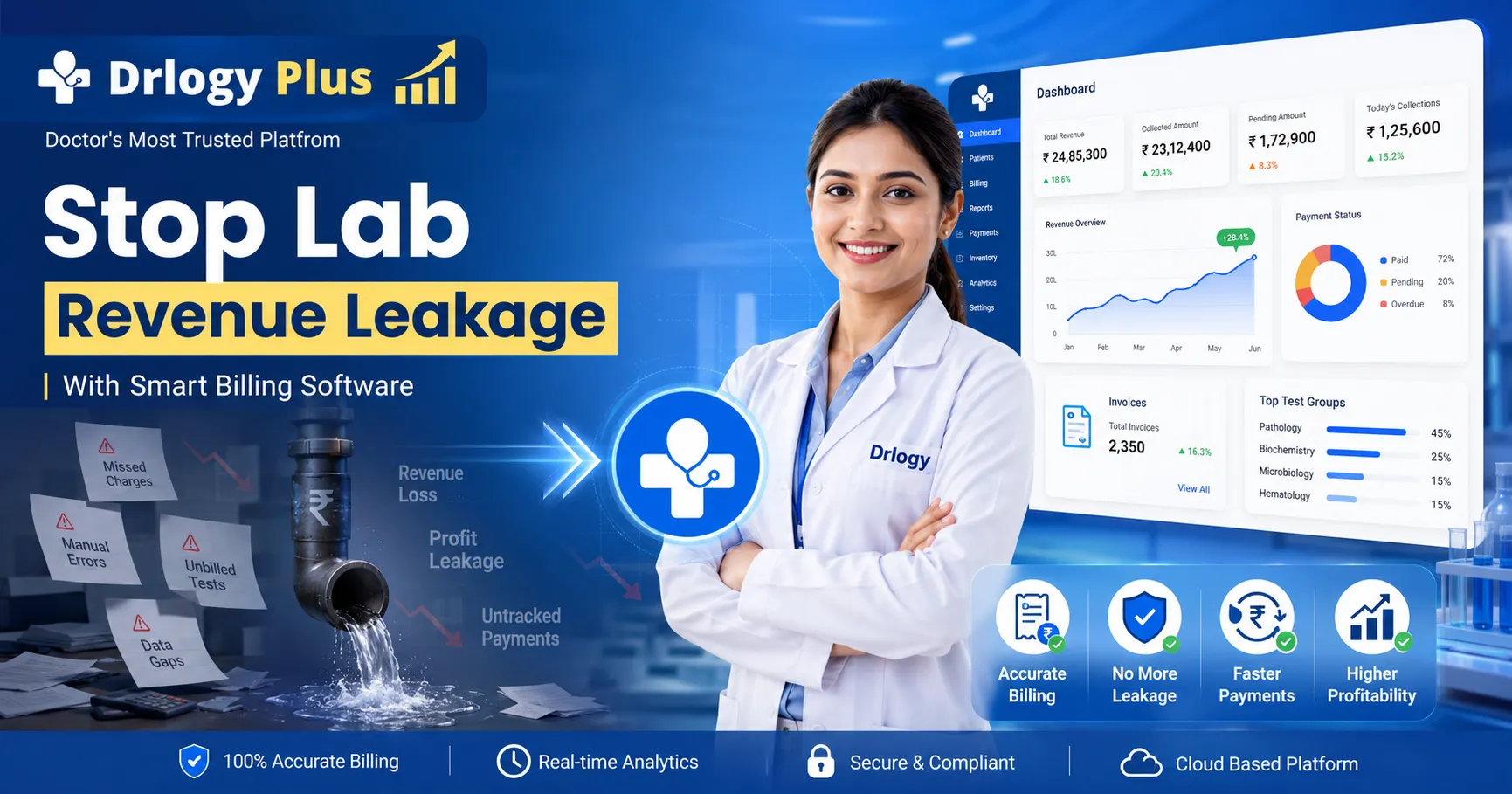
Stop Lab Revenue Leakage With Smart Billing Software
At the end of the day, many pathology lab owners ask one uncomfortable question:
“Patient flow was good today, but why does the final collection still feel low?”
The reception desk was busy. Samples were collected. Reports were generated. Doctors referred patients. Staff worked continuously. Still, when the owner checks the day closing, something does not match.
A few discounts were given manually. Some credit entries were not followed up. One patient paid partially. A corporate bill was pending. A home collection payment was marked later. A staff member forgot to update one receipt.
Nothing looks like a major loss in the moment.
But over a month, these small billing gaps quietly become lab revenue leakage.
For Indian pathology labs, the problem is rarely patient demand alone. Many labs are already getting enough walk-ins, referrals, and repeat patients. The bigger issue is control over billing, collections, discounts, dues, and daily financial visibility.
That is where smart lab billing software becomes more than a billing tool. It becomes a profit-control system.
Revenue Leakage Does Not Always Look Like a Big Mistake
Most lab owners imagine revenue leakage as fraud, theft, or a major billing error. In reality, it is usually much smaller and much more dangerous.
It happens in small daily moments:
- A test discount is given without approval.
- A due payment is not tracked properly.
- A receipt is created late.
- A cash and digital payment mismatch is ignored.
- A credit bill is not reviewed on time.
- A test is performed but billing is incomplete.
- A refund or adjustment is not clearly visible.
- A home collection payment is handled manually.
Each mistake may look minor. But when your lab handles 80, 150, or 300 patients per day, even small gaps become serious.
Many growing diagnostic labs lose 5–15% revenue visibility due to manual billing gaps, discounts, credit entries, and untracked collections. That does not always mean direct loss, but it means the owner cannot clearly see where money is stuck, missed, delayed, or adjusted.
And what the owner cannot see, the owner cannot control.
The Real Problem Is Not Billing. It Is Visibility.
Imagine a pathology lab in Surat handling 120 patients a day. The lab has good doctor referrals, a decent walk-in flow, and regular home collection requests.
On paper, the lab is growing.
But every evening, the owner depends on staff for updates:
“How much cash came today?”
“How much is pending?”
“Which doctor referral bill is unpaid?”
“Who approved this discount?”
“Why is this patient marked as paid but no receipt is visible?”
“Which reports were delivered before payment?”
The issue is not that the staff is careless. The issue is that the billing process depends too much on memory, manual checking, and disconnected records.
Revenue leakage is rarely one big hole. It is usually many small gaps that stay invisible until profit starts shrinking.
This is why smart billing is not only an accounting feature. For a pathology lab owner, it is a daily control system.
Manual Billing Creates Pressure in Growing Labs
Manual billing may work when a lab is small. But once patient volume increases, the same process starts creating risk.
A busy lab has multiple moving parts:
- Reception billing
- Test selection
- Package billing
- Discount approval
- Payment collection
- Credit billing
- Doctor referral tracking
- Home collection payment
- Corporate billing
- Report delivery status
- Refunds and adjustments
When these are not connected, the owner gets only partial information.
The lab may be earning, but the owner does not know the exact leakage points. Staff may be working hard, but billing still lacks accuracy. Patients may be served, but payment discipline becomes weak.
A growing lab cannot run profitably if billing control depends only on people. It needs a system.
That is why many diagnostic centers are shifting from manual billing or basic software to smart, connected lab billing software.
Manual Billing vs Smart Billing Workflow
| Manual Lab Billing | Smart Lab Billing Software |
|---|---|
| Collections checked after closing | Live collection data visible |
| Discounts depend on staff updates | Discount tracking becomes clearer |
| Pending dues checked manually | Due payments are easier to monitor |
| Reports and payments stay separate | Billing and report flow connect |
| Owner depends on verbal updates | Owner gets dashboard visibility |
This simple shift changes how the lab owner makes decisions.
Instead of asking staff for every detail, the owner can review billing, collections, dues, and pending amounts in one place.
Where Pathology Labs Commonly Lose Revenue
Revenue leakage usually starts where daily workflow is fast, repetitive, and dependent on manual updates.
Here are common warning signs:
- Daily patient count is increasing, but profit is not improving.
- Cash, UPI, card, and credit collections are difficult to reconcile.
- Staff gives discounts without clear tracking.
- Pending payments are followed up only when someone remembers.
- Doctor referral or corporate billing is checked late.
- Home collection payments are updated separately.
- Reports are sometimes delivered before payment confirmation.
- The owner cannot see test-wise or department-wise billing trends.
- Monthly revenue reports take too much manual effort.
If two or three of these are happening in your lab, revenue leakage may already exist.
The solution is not only to tell staff to be careful. That may help for a few days. But when workload increases again, the same gaps return.
The better solution is to make billing more visible, trackable, and connected.
A Practical Path to Stop Lab Revenue Leakage
A lab owner does not need to change everything overnight. The right approach is to identify where billing control breaks and fix it step by step.
- Track every bill from patient registration to report delivery.
Billing should not be separate from the lab workflow. Every test, package, payment, and report status should be connected. - Monitor daily cash, digital, credit, and pending payments.
Owners need quick visibility into what was collected, what is pending, and what needs follow-up. - Control discounts and adjustments.
Discounts should be visible, trackable, and reviewable so they do not quietly reduce monthly revenue. - Connect billing with sample and report status.
If the report is ready but payment is pending, the lab should know before delivery. - Review revenue reports before closing the day.
Daily financial visibility helps owners catch leakage early instead of discovering it at month-end.
This is where pathology lab billing software can help labs build better billing discipline without increasing staff pressure.
Smart Billing Helps Owners Move From Guesswork to Control
Many lab owners are not short of effort. They are short of real-time control.
They work long hours, handle staff issues, manage doctors, solve patient complaints, and still check billing manually at the end of the day.
But a lab owner should not have to depend on scattered registers, Excel sheets, WhatsApp messages, or verbal updates to understand business performance.
With Drlogy Pathology Lab Software, billing becomes part of a connected pathology lab workflow. It helps labs manage billing, reports, patient records, collections, and operational visibility in one system.
The goal is not just to create invoices faster.
The goal is to help the owner answer business-critical questions faster:
- How much did the lab collect today?
- How much is pending?
- Which payments are delayed?
- Which discounts were given?
- Which billing gaps need attention?
- Which part of the workflow is slowing revenue collection?
- Which branch, department, or staff process needs review?
When these answers are visible, the owner can stop reacting late and start managing proactively.
Why This Matters More for Indian Pathology Labs Now
Indian diagnostic labs are becoming more competitive. Patients expect faster service. Doctors expect professional reporting. Lab chains and online diagnostic brands are increasing pressure on local labs.
In this environment, billing leakage is not just an internal accounting issue. It affects growth.
If billing is weak, the lab faces:
- Lower profit despite higher workload
- Poor cash flow visibility
- Delayed credit recovery
- Higher staff dependency
- More owner involvement in daily checking
- Weak branch-wise control
- Confusion during audits or monthly review
- Difficulty scaling operations
A lab that wants to grow cannot afford unclear billing.
Growth without billing control increases risk. Growth with smart billing improves confidence.
That is why smart billing software is now a practical business decision for pathology labs, diagnostic centers, hospital labs, and lab chains.
The Psychology Behind Billing Leakage
Most lab owners tolerate small billing gaps because they look manageable.
One pending payment does not feel urgent.
One discount does not look harmful.
One missed receipt may get corrected later.
One delayed credit bill does not create panic.
But the psychology of leakage is dangerous because small issues feel normal.
Over time, staff also starts accepting them as part of routine work. The owner becomes dependent on end-of-day checking. Month-end review becomes stressful. Profit becomes unclear.
A smart billing system changes this behavior because it creates visibility during the workflow, not after the damage is done.
This is where technology helps not by replacing people, but by reducing dependency on memory.
What a Lab Owner Should Look for in Billing Software
Before choosing software, lab owners should check whether the system supports real operational control.
A good pathology lab billing system should help with:
- Fast patient billing
- Test and package billing
- Discount tracking
- Due and credit payment management
- Daily collection reports
- Cash, UPI, card, and other payment modes
- Billing and report workflow connection
- Staff-wise activity visibility
- Branch-wise revenue control
- Easy owner dashboard
- Professional receipts and records
The best billing software is not the one that only prints bills. It is the one that helps the lab owner reduce confusion, improve collection discipline, and track money clearly.
Smart Billing Also Improves Patient Experience
Billing is not only a back-office function. It directly affects patients.
When billing is slow, patients wait.
When payment status is unclear, staff calls repeatedly.
When report delivery depends on manual confirmation, patients get frustrated.
When receipts are delayed, trust reduces.
A smoother billing workflow creates a smoother patient experience.
For labs that want to improve patient convenience, connecting billing with digital reports, patient records, and online access can make a big difference. Solutions like a patient portal for pathology labs can further reduce staff pressure and improve patient communication.
This matters because patients may not understand your internal workflow, but they remember delays, confusion, and repeated calls.
When Should a Lab Owner Take Action?
A lab owner should not wait until revenue leakage becomes obvious. By then, the loss may already be part of the lab’s daily habit.
You should review your billing workflow if:
- You cannot check daily revenue in a few minutes.
- Staff needs time to explain pending payments.
- Discounts are not reviewed regularly.
- Credit billing follow-up is weak.
- Patient volume is increasing but profit clarity is low.
- You are opening a new branch or collection center.
- You depend heavily on one billing person.
- Month-end reconciliation creates stress.
These are not small operational issues. They are early signs that your lab needs stronger billing control.
If your lab is growing but billing visibility still depends on manual checking, it may be the right time to book a free software demo and see how a connected workflow can help.
Conclusion
Lab revenue leakage does not always come from one major mistake. It usually comes from daily billing gaps, unclear discounts, pending payments, manual follow-ups, and poor visibility. Smart lab billing software helps owners identify these issues before they silently affect monthly profit.
For pathology labs that want to grow with control, billing must become connected, visible, and trackable. The right lab billing software gives owners the confidence to manage collections, reduce dependency, and build a stronger business foundation.