Drlogy
Healthcare organization
Pink Top Tube – Blood Bank Tube for Crossmatch & Typing
Pink Top Tubes, also known as EDTA tubes, are crucial components in blood collection for hematological testing.
Check
Their importance lies in preserving blood cell morphology and integrity for accurate analysis. Understanding the science behind Pink Top Tubes and their proper usage ensures reliable results in laboratory diagnostics.
What is a Pink Top Tube and How is it Used in Blood Collection?
A Pink Top Tube, also known as an EDTA tube, is a type of blood collection tube containing the anticoagulant ethylenediaminetetraacetic acid (EDTA). This additive prevents blood clotting by chelating calcium ions, making iteal for collecting whole blood samples for hematological studies.
EDTA tubes are commonly used in laboratories for complete blood counts (CBC), blood typing, and various other hematological tests due to their ability to preserve cellular components.
During blood collection, the Pink Top Tube is filled with the appropriate volume of blood and inverted several times to ensure thorough mixing with the EDTA anticoagulant. Once collected, the tube is labeled with patient information and promptly transported to the laboratory for analysis. The EDTA in the tube helps maintain the integrity of the blood sample by preventing clotting, allowing for accurate hematological testing to be performed.
Science Behind the Pink Top Tube: How Does It Work?
The Pink Top Tube, also known as an EDTA tube, contains ethylenediaminetetraacetic acid (EDTA), an anticoagulant that binds calcium ions, preventing blood clotting. This allows for the collection of whole blood samples for hematological testing without clot formation.
How Does It Work?
- Anticoagulant Presence: EDTA in the tube chelates calcium ions, inhibiting the coagulation cascade.
- Blood Collection: Whole blood is collected into the Pink Top Tube using standard phlebotomy techniques.
- Inversion: The tube is gently inverted several times to ensure thorough mixing of the blood with the EDTA.
- Preventing Clot Formation: EDTA binds to calcium ions, preventing them from participating in the coagulation process.
- Preservation of Cellular Components: By preventing clot formation, the Pink Top Tube preserves the integrity of cellular components in the blood, allowing for accurate hematological testing.
Imporatnce key features of a Pink Top Tube
| Key Feature | Description |
|---|---|
| Anticoagulant | Contains ethylenediaminetetraacetic acid (EDTA) |
| Color | Pink |
| Tube Type | Blood collection tube |
| Volume Range | Typically ranges from 2 to 10 mL |
| Material | Made of plastic or glass |
| Mixing Requirement | Requires gentle inversion after blood collection |
| Storage and Stability | Store at room temperature (15-30°C); stable until expiration |
| Labeling | Must be labeled with patient information, date, and time of collection |
| Compatibility | Compatible with automated analyzers for hematological testing |
These key features highlight the composition, handling requirements, and storage conditions of Pink Top Tubes, ensuring the preservation of blood samples for accurate hematological testing.
Here are the top 10 laboratory tests that commonly use Pink Top Tubes:
- Complete Blood Count (CBC): Provides information about red blood cells, white blood cells, and platelets.
- Blood Typing: Determines a person's blood group (A, B, AB, or O) and Rh factor (positive or negative).
- Erythrocyte Sedimentation Rate (ESR): Measures the rate at which red blood cells settle in a tube over time, indicating inflammation levels.
- Hemoglobin Electrophoresis:entifies abnormal forms of hemoglobin in the blood, such as in sickle cell disease.
- Blood Film Examination: Evaluates the morphology of blood cells under a microscope, detecting abnormalities like malaria parasites or blood cell disorders.
- Hematocrit: Measures the percentage of red blood cells in the blood, aiding in the diagnosis of anemia or polycythemia.
- Peripheral Blood Smear: Provides detailed information about the size, shape, and structure of blood cells, aiding in the diagnosis of various blood disorders.
- Coagulation Studies: Assesses the blood's ability to clot properly, including tests like prothrombin time (PT), activated partial thromboplastin time (aPTT), and fibrinogen levels.
- Lead Testing: Determines lead levels in the blood, crucial for diagnosing lead poisoning.
- Red Cell Indices: Includes tests like mean corpuscular volume (MCV), mean corpuscular hemoglobin (MCH), and mean corpuscular hemoglobin concentration (MCHC), providing information about the size and hemoglobin content of red blood cells.
Best Practices for Using Pink Top Tube in Phlebotomy
Here are 7 best practices for using Pink Top Tubes in phlebotomy:
- Properentification: Ensure correct labeling with patient information and collection details.
- Use Correct Tubes: Select Pink Top Tubes specifically designed for EDTA anticoagulant.
- Gentle Inversion: After blood collection, gently invert the tube several times to mix blood with EDTA.
- Avoid Hemolysis: Use proper needle size and technique to minimize cell damage.
- Fill to Capacity: Collect adequate blood volume to maintain proper blood-to-anticoagulant ratio.
- Prevent Clots: Promptly cap the tube to prevent air exposure and clot formation.
- Timely Processing: Transport Pink Top Tubes to the lab promptly for analysis to ensure accurate results.
10 Step-by-Step Guide to Proper Pink Top Tube Usage
Here's a step-by-step guide to properly using Pink Top Tubes in blood collection:
- Prepare Equipment: Gather necessary supplies, including Pink Top Tubes, needles, alcohol swabs, and tourniquets.
- Patiententification: Verify patiententity using twoentifiers and explain the procedure.
- Select Site: Choose a suitable vein for blood collection, typically in the antecubital fossa.
- Prepare the Patient: Apply a tourniquet above the selected site and instruct the patient to form a fist.
- Cleanse the Site: Disinfect the puncture site with an alcohol swab and allow it to dry completely.
- Venipuncture: Perform venipuncture using a sterile needle and collect the required volume of blood into the Pink Top Tube.
- Mixing: Immediately after collection, gently invert the Pink Top Tube several times to ensure proper mixing of blood with the anticoagulant.
- Cap the Tube: Cap the tube securely to prevent leakage and contamination.
- Labeling: Label the Pink Top Tube with patiententification, date, time, and any other necessary information.
- Transport: Place the labeled Pink Top Tube in a specimen bag and transport it to the laboratory promptly for analysis.
7 Common Mistakes to Avoid When Using Pink Top Tube
Here are 7 common mistakes to avoid when using Pink Top Tubes:
- Incomplete Mixing: Failing to invert the tube properly after blood collection can result in inadequate mixing of blood with the anticoagulant, leading to inaccurate test results.
- Underfilling or Overfilling: Collecting an insufficient or excessive volume of blood can affect the blood-to-anticoagulant ratio, compromising the integrity of the sample.
- Delayed Processing: Allowing Pink Top Tubes to sit for too long before processing can lead to clot formation or changes in blood cell morphology, impacting test accuracy.
- Using Expired Tubes: Using Pink Top Tubes past their expiration date can result in ineffective anticoagulation, affecting sample quality and test results.
- Incorrect Labeling: Failing to label Pink Top Tubes accurately with patient information, date, and time of collection can lead to sample misidentification and errors in result reporting.
- Improper Storage: Storing Pink Top Tubes at incorrect temperatures or exposing them to light or heat can compromise the stability of the sample, affecting test results.
- Ignoring Patient Safety: Neglecting proper patiententification, vein selection, or disinfection procedures can increase the risk of contamination and patient discomfort during blood collection.
5 Innovations and Advances in Blood Collection: The Future of Pink Top Tube
- Improved Anticoagulants: Future Pink Top Tubes may incorporate advanced anticoagulants with enhanced stability and efficacy, ensuring optimal preservation of blood samples for extended periods.
- Microsampling Technology: Miniaturized Pink Top Tubes equipped with microsampling technology could revolutionize blood collection by requiring smaller sample volumes, reducing patient discomfort and specimen waste.
- Smart Labels: Integration of smart labels or RFID technology on Pink Top Tubes may enable real-time tracking of sample location and status, streamlining inventory management and enhancing sample traceability.
- Biodegradable Materials: Development of Pink Top Tubes using eco-friendly and biodegradable materials could reduce environmental impact while maintaining sample integrity and safety.
- Point-of-Care Testing Integration: Integration of diagnostic assaysectly into Pink Top Tubes could facilitate rapid on-site testing, allowing for immediate results and enabling timely clinical decisions.
FAQS: Pink Top Tube
What is a Pink Top Tube used for?
- Pink Top Tubes, also known as EDTA tubes, are used for collecting whole blood specimens for hematological testing. The EDTA anticoagulant preserves blood cell morphology and allows for accurate analysis of blood cell counts and morphology.
How does a Pink Top Tube work?
- A Pink Top Tube contains ethylenediaminetetraacetic acid (EDTA), which binds calcium ions, preventing blood from clotting. This allows for the collection of whole blood specimens without clot formation, preserving the integrity of blood cells for hematological testing.
How much blood is needed in a Pink Top Tube?
- The volume of blood needed in a Pink Top Tube depends on the specific test being performed. However, typically, Pink Top Tubes can hold between 2 to 10 milliliters of blood.
How long can a blood sample in a Pink Top Tube be stored?
- Blood samples collected in Pink Top Tubes can typically be stored at room temperature (15-30°C) for up to 24 hours before analysis. However, for some tests requiring extended storage, refrigeration may be necessary.
Can Pink Top Tubes be used for glucose testing?
- Pink Top Tubes are not suitable for glucose testing as EDTA can interfere with glucose measurement. Tubes with fluoride additives are preferred for glucose testing as they stabilize blood glucose levels.
Can Pink Top Tubes be used for DNA testing?
- Pink Top Tubes are not recommended for DNA testing as EDTA can inhibit DNA polymerase, affecting DNA amplification. Tubes with specific additives, such as those used for DNA extraction, are preferred for DNA testing.
Are Pink Top Tubes reusable?
- No, Pink Top Tubes are single-use disposable devices. Reusing tubes can lead to contamination and inaccurate test results. Proper disposal of used Pink Top Tubes is necessary to maintain sample integrity and laboratory safety.
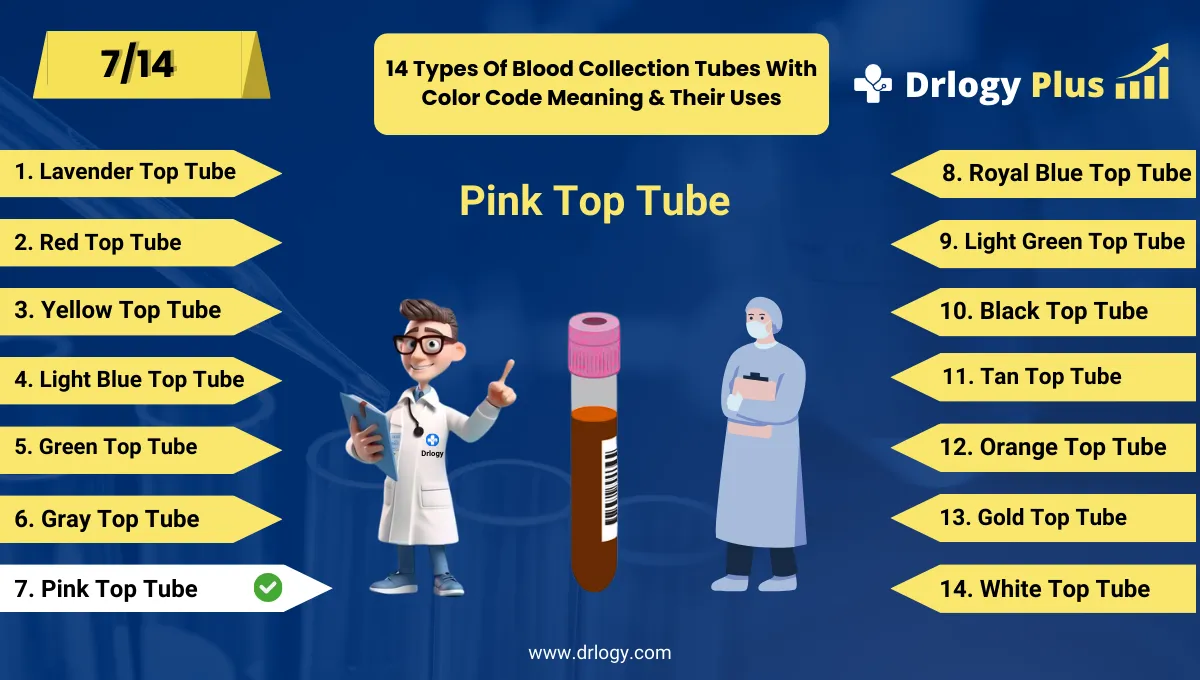
Drlogy Blood Cllection Tube Guide
Here are 14 types of blood colelction tubes with color.
Conclusion
Pink Top Tubes play a pivotal in modern healthcare by facilitating precise hematological testing. As technology advances, innovations in Pink Top Tube design promise to further enhance blood collection practices, ensuring continued accuracy and efficiency in diagnostic procedures.Check Complete Guide on Drlogy Blood Collection Tubes with Color Codes & Uses to master phlebotomy techniques, improve sample handling, and reduce pre-analytical errors