Drlogy
Healthcare organization
Lavender (Purple) Top Tube – EDTA for CBC & Hematology Tests
The Lavender (Purple) Top Tube stands as a fundamental tool in clinical laboratories, especially renowned for its in hematology tests. With its distinct color and vital additive, this tube plays a pivotal in ensuring precise and dependable blood test outcomes.
Check
This blog embarks on an exploration of the Lavender Top Tube, unveiling its intricacies, applications, and optimal handling practices, thereby enlightening readers on its indispensable significance in medical diagnostics.
What is a Lavender (Purple) Top Tube and How is it Used in Blood Collection?
A Lavender (Purple) Top Tube is a specialized blood collection tube commonly used in clinical laboratories for hematology tests. It contains EDTA (ethylenediaminetetraacetic acid) as an anticoagulant, which prevents blood from clotting by binding calcium ions. This feature is crucial for maintaining the integrity of blood samples, especially for tests that require whole blood or plasma. The tube's distinctive purple color makes it easilyentifiable, ensuring proper handling and processing in laboratory settings.
In blood collection, the Lavender Top Tube is primarily used for complete blood counts (CBC), which assess various components of blood, including red and white blood cells, and platelets. It is also essential for tests like hemoglobin A1c, which monitors long-term blood glucose control in diabetic patients. After collection, the tube is gently inverted several times to mix the blood with EDTA, preventing clotting. Proper handling and timely processing are vital to ensure the accuracy and reliability of the test results, making the Lavender Top Tube an indispensable tool in medical diagnostics.
Science Behind the Lavender (Purple) Top Tube
Definition: The Lavender (Purple) Top Tube contains EDTA as an anticoagulant, which prevents blood from clotting by binding calcium ions, essential for accurate hematology tests.
How Does It Work?
- Draw Blood: Collect blood into the Lavender Top Tube.
- Mix with EDTA: Gently invert the tube 8-10 times to mix blood with the EDTA.
- Prevent Clotting: EDTA binds calcium ions, preventing the blood from clotting.
- Transport to Lab: Properly label and transport the tube to the laboratory.
- Analyze Sample: Use the anticoagulated blood for hematology tests like CBC and hemoglobin A1c.
Importance key features of a Lavender (Purple) Top Tube
| Key Feature | Description |
|---|---|
| Additive | Contains EDTA (ethylenediaminetetraacetic acid) as an anticoagulant, which binds calcium ions to prevent blood clotting. |
| Color | Purple-colored cap or stopper, making it easilyentifiable for specific hematology tests. |
| Tube Type | EDTA Tube, designed for collecting whole blood samples. |
| Common Uses | Used for complete blood counts (CBC), hemoglobin A1c, blood smears, and other hematology tests. |
| Volume Range | Typically available in sizes ranging from 2 to 10 mL, depending on the test requirements. |
| Material | Made of plastic or glass, depending on the manufacturer and specific use. |
| Mixing Requirement | Requires gentle inversion (8-10 times) immediately after collection to ensure proper mixing of blood and EDTA. |
| Storage and Stability | Blood samples in Lavender Top Tubes should be stored at appropriate temperatures and processed promptly to ensure accuracy. |
| Labeling | Requires proper labeling with patient information, date, and time of collection for accurateentification and traceability. |
| Compatibility | Suitable for various automated hematology analyzers and manual testing methods. |
This table provides a concise overview of the important features of a Lavender (Purple) Top Tube, highlighting its components, uses, and handling requirements.
Top 10 Laboratory Tests That Use Lavender (Purple) Top Tube
Complete Blood Count (CBC): Evaluates overall health by measuring various components of blood, including red and white blood cells, hemoglobin, hematocrit, and platelets.
Hemoglobin A1c (HbA1c): Monitors long-term blood glucose control in diabetic patients by measuring the percentage of glycated hemoglobin.
Erythrocyte Sedimentation Rate (ESR): Assesses inflammation in the body by measuring the rate at which red blood cells settle in a tube over a specified period.
Reticulocyte Count: Determines the number of young red blood cells (reticulocytes) in the blood, helping to evaluate bone marrow function and anemia.
Peripheral Blood Smear: Examines the morphology of blood cells under a microscope, aiding in the diagnosis of various blood disorders, such as anemia, infections, and leukemias.
Flow Cytometry: Analyzes the physical and chemical characteristics of blood cells, often used in the diagnosis and monitoring of leukemia and lymphoma.
Blood Typing: Determines an individual's blood group (A, B, AB, or O) and Rh factor (positive or negative) for blood transfusion compatibility.
Crossmatch: Ensures compatibility between a blood donor and recipient by mixing a small amount of donor red blood cells with the recipient’s serum to check for agglutination.
CD4 Count: Measures the number of CD4 T lymphocytes in the blood, crucial for monitoring the immune function of HIV patients.
Parathyroid Hormone (PTH): Monitors levels of PTH in the blood, important for diagnosing and managing conditions related to calcium imbalances and parathyroid disorders.
These tests highlight the versatility and essential of the Lavender (Purple) Top Tube in various diagnostic and monitoring processes within clinical laboratories.
Best Practices for Using Lavender (Purple) Top Tube in Phlebotomy
Verify Patient Information: Always confirm the patient’sentity and ensure accurate labeling of the tube to prevent mix-ups.
Choose the Right Vein: Select an appropriate vein, typically in the antecubital area, for a successful and efficient blood draw.
Clean the Puncture Site: Disinfect the venipuncture site with an alcohol swab and allow it to air dry to prevent contamination.
Use Proper Technique: Perform venipuncture with the correct needle size and angle to minimize discomfort and ensure an adequate blood sample.
Mix Immediately: Gently invert the tube 8-10 times immediately after blood collection to mix the blood with the EDTA anticoagulant thoroughly.
Avoid Hemolysis: Handle the tube gently and avoid excessive shaking to prevent hemolysis, which can compromise sample integrity.
Timely Processing: Ensure the blood sample is transported and processed promptly according to lab guidelines to maintain the accuracy of test results.
10 Step-by-Step Guide to Proper Lavender (Purple) Top Tube Usage
Gather Supplies
- Collect all necessary materials including Lavender (Purple) Top Tubes, needles, tourniquet, alcohol swabs, and gloves. Ensure all equipment is sterile and ready for use.
Verify Patiententity
- Confirm the patient'sentity using at least twoentifiers (e.g., name and date of birth). Properly label the Lavender Top Tube with the patient's information before the blood draw to avoid any mix-ups.
Prepare the Collection Site
- Apply a tourniquet above the venipuncture site to engorge the veins. Clean the chosen puncture site with an alcohol swab in a circular motion from the inside out. Allow the site to air dry completely to ensure sterilization.
Perform Venipuncture
- Insert the needle into the vein at a 15-30 degree angle with a swift and steady motion. Ensure the Lavender Top Tube is connected securely to the needle holder to start the blood draw.
Collect Blood
- Allow the blood to flow into the Lavender Top Tube until it reaches the required fill line. This ensures there is the correct ratio of blood to EDTA anticoagulant. Do not overfill or underfill the tube.
Mix the Sample
- Immediately after collection, gently invert the Lavender Top Tube 8-10 times to mix the blood with the EDTA anticoagulant. This step is crucial to prevent clotting and ensure accurate test results.
Remove the Needle and Apply Pressure
- Once the tube is filled, remove the needle from the patient's vein. Apply pressure to the puncture site with a clean gauze pad to stop any bleeding. Dispose of the needle in a sharps container.
Label the Tube
- Ensure the tube is labeled accurately with the patient's information, date, and time of collection if this has not already been done. This step is essential for properentification and traceability of the sample.
Transport to Lab
- Transport the Lavender Top Tube to the laboratory promptly. Ensure the tube is stored upright and at the appropriate temperature to maintain sample integrity until analysis.
Process the Sample
- In the lab, the sample will be analyzed according to the specific test requirements. The EDTA in the Lavender Top Tube will ensure the blood remains anticoagulated and suitable for various hematology tests.
7 Common Mistakes to Avoid When Using Lavender (Purple) Top Tube
Incorrect Labeling
- Mistake: Failing to label the tube immediately after collection or incorrectly labeling it.
- Avoidance: Always label the tube with the patient's information, date, and time of collection before or immediately after drawing blood.
Inadequate Mixing
- Mistake: Not inverting the tube enough times after collection.
- Avoidance: Gently invert the tube 8-10 times immediately after collection to mix the blood with the EDTA anticoagulant properly.
Overfilling or Underfilling the Tube
- Mistake: Not filling the tube to the required volume.
- Avoidance: Ensure the blood reaches the marked fill line to maintain the correct blood-to-EDTA ratio for accurate test results.
Delayed Processing
- Mistake: Waiting too long to transport or process the blood sample.
- Avoidance: Transport and process the Lavender Top Tube promptly to prevent deterioration of the sample.
Improper Storage
- Mistake: Storing the tube at incorrect temperatures or inappropriately positioning it.
- Avoidance: Store the tube upright and at the recommended temperature until it is analyzed.
Using the Wrong Tube
- Mistake: Using a Lavender Top Tube for tests that do not require EDTA.
- Avoidance: Verify the test requirements and use the appropriate tube for each specific test to avoid interference from the anticoagulant.
Hemolysis Due to Rough Handling
- Mistake: Shaking or handling the tube roughly, leading to hemolysis.
- Avoidance: Handle the tube gently and avoid vigorous shaking to preserve the integrity of the blood cells and the sample.
5 Innovations and Advances in Blood Collection: The Future of Lavender (Purple) Top Tube
Improved Anticoagulant Formulations
- Innovation: Development of enhanced EDTA formulations that improve the preservation of blood cell integrity and extend the shelf life of samples.
- Impact: Ensures more accurate hematology test results and reduces the need for immediate processing, allowing for more flexible sample handling.
Micro-Collection Systems
- Innovation: Introduction of micro-collection systems designed for pediatric and geriatric patients, which require smaller blood volumes while still using the Lavender Top Tube technology.
- Impact: Minimizes discomfort for patients who need frequent blood draws and ensures reliable sample quality from smaller volumes.
Integrated RFID and Barcode Technology
- Innovation: Embedding RFID chips and barcodes in Lavender Top Tubes for better tracking and management of samples throughout the collection and analysis process.
- Impact: Enhances sample traceability, reduces labeling errors, and improves efficiency in laboratories by automating the tracking process.
Vacuum-Controlled Collection Tubes
- Innovation: Development of vacuum-controlled Lavender Top Tubes that precisely regulate the amount of blood drawn.
- Impact: Reduces the risk of hemolysis and ensures consistent sample volumes, leading to more reliable test results.
Enhanced Material and Design
- Innovation: Use of advanced materials and ergonomic designs to improve the durability and usability of Lavender Top Tubes.
- Impact: Increases user comfort, reduces the risk of tube breakage, and improves the overall experience for both phlebotomists and patients during blood collection.
FAQS: Blood Collection Lavender (Purple) Top Tube
1. What is the purpose of a Lavender (Purple) Top Tube in blood collection?
- The Lavender Top Tube contains an anticoagulant (EDTA) that prevents blood from clotting, making iteal for hematology tests like complete blood counts (CBC) and erythrocyte sedimentation rate (ESR).
2. Can a Lavender Top Tube be used for other types of blood tests?
- Yes, Lavender Top Tubes are primarily used for hematology tests, but they can also be used for some molecular and immunological assays, such as DNA extraction and flow cytometry.
3. How much blood is required for a Lavender Top Tube?
- Lavender Top Tubes typically require 2-5 milliliters of blood, depending on the specific test requirements. It's essential to fill the tube to the indicated fill line to ensure accurate results.
4. How long can blood samples in Lavender Top Tubes be stored?
- Blood samples in Lavender Top Tubes can be stored for up to 24 hours at room temperature or up to 48 hours when refrigerated at 2-8°C before analysis. Prompt processing is recommended for optimal results.
5. What are the common tests performed using blood samples in Lavender Top Tubes?
- Common tests include complete blood counts (CBC), hemoglobin A1c (HbA1c), erythrocyte sedimentation rate (ESR), reticulocyte count, and peripheral blood smears for microscopic examination.
6. Can blood samples in Lavender Top Tubes be frozen for long-term storage?
- It's generally not recommended to freeze blood samples in Lavender Top Tubes as freezing may alter the cellular components and compromise test results. Samples should be analyzed promptly or refrigerated for short-term storage.
7. Are there any special considerations for pediatric patients when using Lavender Top Tubes?
- Yes, for pediatric patients, it's crucial to use smaller-volume Lavender Top Tubes to minimize blood loss and discomfort. Additionally, proper technique and gentle handling are essential to ensure accurate results and patient comfort.
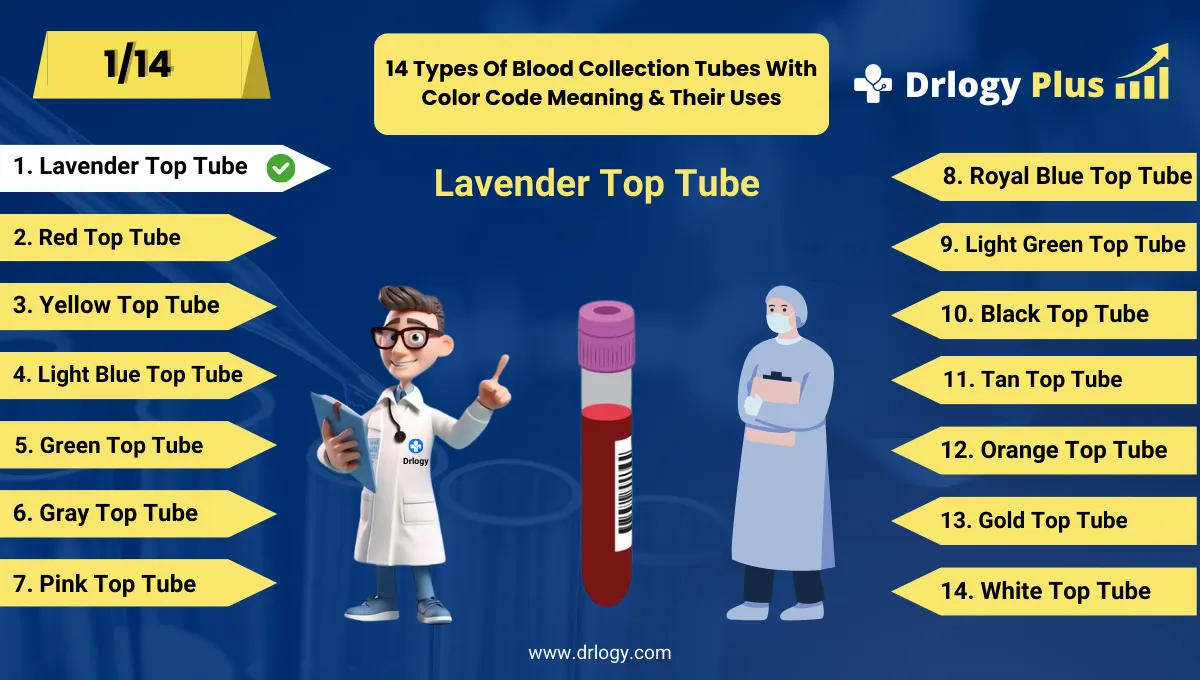
Drlogy Blood Cllection Tube Guide
Here are 14 types of blood colelction tubes with color.
Conclusion
The Lavender (Purple) Top Tube emerges as an indispensable component in the realm of clinical diagnostics. Its enduring importance lies in its ability to facilitate accurate and reliable blood tests, thereby aiding healthcare professionals in their quest for precise patient diagnoses and management.
Check Complete Guide on Drlogy Blood Collection Tubes with Color Codes & Uses to master phlebotomy techniques, improve sample handling, and reduce pre-analytical error