Drlogy
Healthcare organization
Green Top Tube – Heparin Tube for Plasma Chemistry
The Green Top Tube stands as a crucial tool in the realm of laboratory diagnostics, playing a pivotal in the collection and analysis of blood samples.
Check
In this essential guide, we embark on a journey to uncover the significance of the Green Top Tube in modern clinical laboratories. From understanding its composition and function to exploring its diagnostic applications and best practices for usage, this guide aims to provide comprehensive insights into the pivotal of the Green Top Tube in blood collection practices.
What is a Green Top Tube and How is it Used in Blood Collection?
A Green Top Tube, also known as a lithium heparin tube, is a type of blood collection tube that contains lithium heparin as an anticoagulant. Its distinctive green color helps in easyentification within the laboratory. The anticoagulant, lithium heparin, works by inhibiting the clotting cascade, preventing blood from clotting and preserving plasma for various laboratory tests. Green Top Tubes are primarily used for collecting blood samples for clinical chemistry tests, such as electrolyte panels, liver function tests, and hormone assays. The plasma obtained from these tubes provides valuable insights into the biochemical composition of the blood, aiding in the diagnosis and management of various medical conditions.
During blood collection, the Green Top Tube is typically used for venous blood draws. After the blood draw, the tube is gently inverted several times to ensure thorough mixing of the blood with the lithium heparin anticoagulant. This step is crucial for preventing clot formation and ensuring the stability of the plasma sample. Once properly mixed, the tube is labeled with patient information and transported to the laboratory for analysis. Green Top Tubes play a vital in clinical chemistry testing, providing clinicians with valuable information about a patient's metabolic and biochemical status, aiding in the diagnosis and monitoring of diseases.
Science Behind the Green Top Tube: Understanding Its Additive and Function
The Green Top Tube contains lithium heparin as an additive, which acts as an anticoagulant by inhibiting the clotting cascade, preserving plasma for clinical chemistry tests.
Understanding Its Additive and Function:
- Anticoagulant Action: Lithium heparin binds to antithrombin, inhibiting thrombin formation and preventing blood clotting.
- Preservation of Plasma: Heparin preserves plasma by preventing clot formation, enabling accurate clinical chemistry analysis.
- Chelation of Calcium: Heparin chelates calcium ions, disrupting coagulation factor activation and prolonging clotting times.
- Sample Integrity: Proper mixing ensures uniform distribution of heparin, maintaining sample integrity during transportation and processing.
- Compatibility: Lithium heparin is suitable for a wide range of clinical chemistry tests, providing reliable results for various analytes.
Importance key features of a Green Top Tube
| Key Feature | Description |
|---|---|
| Anticoagulant | Contains lithium heparin as an anticoagulant, which inhibits the clotting cascade by binding to antithrombin III, preserving plasma for clinical chemistry tests. |
| Color | Green-colored cap or stopper, facilitating easyentification within the laboratory and indicating its specific use for clinical chemistry and blood gas analysis. |
| Tube Type | Lithium heparin tube, designed for collecting venous blood samples for clinical chemistry testing, including electrolyte panels and enzyme assays. |
| Volume Range | Available in various sizes, typically ranging from 2 to 10 mL, depending on the laboratory's requirements and the specific tests being performed. |
| Material | Made of plastic or glass, depending on the manufacturer and specific usage requirements. |
| Mixing Requirement | Requires gentle inversion (8-10 times) immediately after blood collection to ensure proper mixing of blood with lithium heparin anticoagulant. |
| Storage and Stability | Blood samples in Green Top Tubes should be stored at room temperature and processed promptly to prevent clot formation and ensure accurate test results. |
| Labeling | Proper labeling with patient information, date, and time of collection is essential for accurate sampleentification and traceability. |
| Compatibility | Suitable for a wide range of clinical chemistry tests, including electrolyte panels, liver function tests, and hormone assays, providing comprehensive diagnostic insights. |
This table provides a concise overview of the important features of a Green Top Tube, emphasizing its in clinical chemistry testing and the necessary precautions for sample handling and processing.
Top 10 Laboratory Tests That Use Green Top Tube
Basic Metabolic Panel (BMP)
- Measures glucose, electrolytes, and kidney function markers like creatinine and blood urea nitrogen (BUN).
Comprehensive Metabolic Panel (CMP)
- Expands on the BMP by including liver function tests such as alanine aminotransferase (ALT), aspartate aminotransferase (AST), and bilirubin.
Liver Function Tests (LFTs)
- Measures enzymes like ALT, AST, alkaline phosphatase (ALP), and bilirubin to assess liver health and function.
Lipid Profile
- Evaluates cholesterol levels, including total cholesterol, HDL (high-density lipoprotein), LDL (low-density lipoprotein), and triglycerides.
Electrolyte Panel
- Measures levels of electrolytes such as sodium, potassium, chloride, and bicarbonate to assess electrolyte balance and kidney function.
Troponin
- Detects levels of cardiac troponin proteins, indicating heart muscle damage, often used in diagnosing heart attacks.
Digoxin Level
- Measures the concentration of the medication digoxin in the blood to ensure therapeutic levels and prevent toxicity.
Theophylline Level
- Determines the concentration of theophylline, a medication used to treat respiratory conditions like asthma and COPD.
Ammonia Level
- Assesses ammonia levels in the blood, which can indicate liver disease or dysfunction.
Arterial Blood Gas (ABG)
- Measures pH, oxygen, and carbon dioxide levels in arterial blood to assess respiratory and metabolic function.
These tests utilize plasma obtained from Green Top Tubes, providing crucial diagnostic insights into various aspects of health and disease.
Best Practices for Using Green Top Tube in Phlebotomy
Correctentification: Ensure proper labeling of the Green Top Tube with patient information before blood collection.
Gentle Handling: Handle the tube with care to avoid breakage and maintain sample integrity.
Proper Mixing: Invert the tube gently 8-10 times immediately after blood collection to ensure thorough mixing of blood with the anticoagulant.
Correct Volume: Fill the tube to the indicated fill line to maintain the proper blood-to-anticoagulant ratio for accurate test results.
Timely Processing: Transport the tube to the laboratory promptly and process the sample within the recommended time frame to prevent clot formation.
Storage Conditions: Store the tube at room temperature and avoid exposure to extreme temperatures orect sunlight to preserve sample stability.
Documentation: Accurately document collection time, handling procedures, and any deviations from standard protocols for traceability and quality assurance.
10 Step-by-Step Guide to Proper Green Top Tube Usage
Prepare Equipment: Gather all necessary supplies, including a Green Top Tube, alcohol swab, tourniquet, sterile needle, and adhesive bandage.
Patiententification: Verify patient information, ensuring accuracy and confirming informed consent for the procedure.
Select Venipuncture Site: Choose an appropriate vein, typically in the antecubital fossa, and cleanse the area with an alcohol swab.
Apply Tourniquet: Apply a tourniquet proximal to the venipuncture site to engorge the veins and facilitate blood collection.
Perform Venipuncture: Use proper phlebotomy technique to insert the needle into the vein at a slight angle, ensuring smooth entry and minimal discomfort for the patient.
Collect Blood: Allow the blood to flow freely into the Green Top Tube, filling it to the indicated fill line.
Mix Blood and Anticoagulant: Immediately after collection, invert the Green Top Tube gently 8-10 times to ensure thorough mixing of blood with the anticoagulant.
Remove Needle and Apply Pressure: Once the tube is filled, withdraw the needle smoothly and apply pressure to the puncture site with a sterile gauze pad to minimize bleeding.
Label Tube: Properly label the Green Top Tube with patient information, collection date, and any other requiredentifiers to ensure accurate sampleentification.
Transport to Laboratory: Transport the labeled Green Top Tube to the laboratory promptly, following appropriate storage and transportation guidelines to maintain sample integrity.
7 Common Mistakes to Avoid When Using Green Top Tube
Incomplete Labeling: Ensure accurate and complete labeling of the Green Top Tube with patient information, date, and time of collection to prevent sample mix-ups.
Rough Handling: Handle the tube with care to avoid breakage and maintain sample integrity, as rough handling can lead to hemolysis or clot formation.
Underfilling or Overfilling: Fill the tube to the indicated fill line to maintain the correct blood-to-anticoagulant ratio, avoiding underfilling, which may result in inadequate mixing, or overfilling, which can affect test accuracy.
Delayed Mixing: Immediately invert the Green Top Tube gently 8-10 times after blood collection to ensure proper mixing of blood with the anticoagulant, preventing clot formation.
Improper Storage: Store the tube at room temperature and avoid exposure to extreme temperatures orect sunlight, as improper storage conditions can affect sample stability and test results.
Delayed Processing: Transport the tube to the laboratory promptly and process the sample within the recommended time frame to prevent clot formation and ensure accurate test results.
Incorrect Test Selection: Ensure appropriate tests are ordered for samples collected in Green Top Tubes, as using them for tests that require different anticoagulants may lead to erroneous results.
5 Innovations and Advances in Blood Collection: The Future of Green Top Tube
Smart Labeling Technology: Integration of RFID (Radio-Frequencyentification) or barcode technology into Green Top Tubes for automated tracking and sample management, enhancing traceability and reducing errors.
Improved Anticoagulant Formulations: Development of novel anticoagulant formulations with enhanced stability and efficacy, ensuring reliable preservation of plasma samples for extended periods.
Microsampling Devices: Introduction of microsampling devices compatible with Green Top Tubes, allowing for smaller blood volumes to be collected, particularly beneficial for pediatric and geriatric patients.
Automation and Robotics: Implementation of automated blood collection systems and robotic phlebotomy devices, optimizing sample collection efficiency, reducing human error, and enhancing patient comfort.
Point-of-Care Testing Integration: Integration of point-of-care testing (POCT) capabilitiesectly into Green Top Tubes, enabling rapid on-site analysis of blood samples for immediate diagnostic insights, especially in emergency and remote settings.
FAQS: Green Top Tube
1. What is a Green Top Tube used for in blood collection?
- A Green Top Tube, also known as a lithium heparin tube, is primarily used for collecting blood samples for clinical chemistry tests, including electrolyte panels, liver function tests, and hormone assays.
2. How does a Green Top Tube work?
- The Green Top Tube contains lithium heparin as an anticoagulant, which prevents blood from clotting by inhibiting the clotting cascade, preserving plasma for clinical chemistry analysis.
3. Can a Green Top Tube be used for other blood tests?
- While primarily used for clinical chemistry tests, a Green Top Tube may also be suitable for certain other tests requiring plasma samples, such as therapeutic drug monitoring.
4. How much blood is needed for a Green Top Tube?
- Green Top Tubes typically require a specific volume of blood, commonly ranging from 2 to 10 milliliters, depending on the laboratory's requirements and the specific tests being performed.
5. Are there any special handling instructions for Green Top Tubes?
- Yes, Green Top Tubes should be gently inverted 8-10 times immediately after blood collection to ensure proper mixing of blood with the anticoagulant, lithium heparin.
6. How long can blood samples in a Green Top Tube be stored?
- Blood samples in Green Top Tubes can typically be stored for up to 24 hours at room temperature or up to 48 hours when refrigerated at 2-8°C before analysis.
7. What are the differences between Green Top Tubes and other blood collection tubes?
- Green Top Tubes contain lithium heparin as an anticoagulant and are specifically designed for clinical chemistry tests, whereas other tubes may contain different additives and are used for various other types of blood tests.
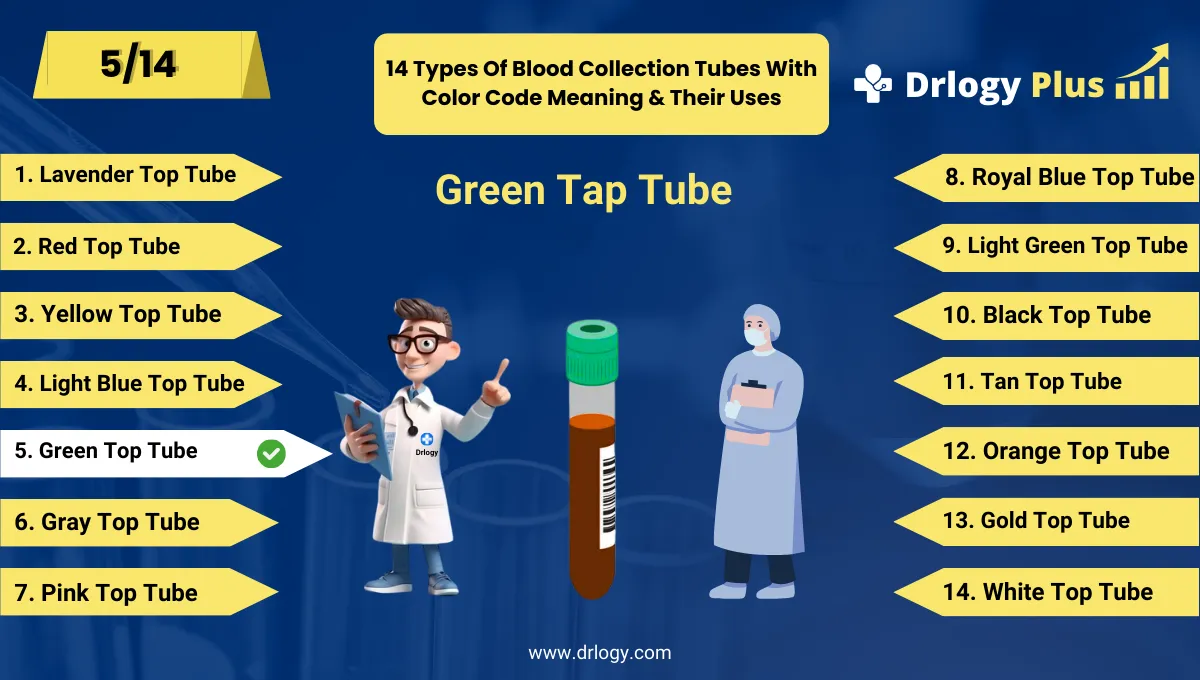
Drlogy Blood Cllection Tube Guide
Here are 14 types of blood colelction tubes with color.
Conclusion
The Green Top Tube emerges as an indispensable component in laboratory diagnostics, facilitating accurate and reliable analysis of blood samples for a wide range of clinical tests. With its carefully crafted composition, precise handling protocols, and ongoing technological advancements.
Check Complete Guide on Drlogy Blood Collection Tubes with Color Codes & Uses to master phlebotomy techniques, improve sample handling, and reduce pre-analytical errors