Drlogy
Healthcare organization
Why MRD Management Features For Hospital Administration Software
Implementing an MRD (Medical Records Department) management feature in hospital administration software is crucial for maintaining accurate, secure, and accessible patient records.
Recommended
This Feature not only enhances patient care and compliance with regulations but also improves overall hospital efficiency and operational workflow.
10 Reasons Why MRD Management Feature Must For Hospital Administration Software
Here are 10 Reasons Why MRD Management Feature Must For Hospital Administration Software.
1. Centralized Patient Record Management
- Efficient Record Storage: Centralizes all patient records, making it easy for healthcare providers to access patient history and treatment details in one place.
- Streamlined Retrieval Process: Simplifies the process of retrieving patient records, ensuring that healthcare professionals can quickly access the information they need.
- Organized Data Archiving: Offers organized archiving of medical records, allowing for quickentification and retrieval of older files when necessary.
- Improved Data Accuracy: Reduces the chances of data duplication or errors by maintaining a single, accurate record for each patient.
- Enhanced Coordination: Facilitates better coordination among departments by providing consistent and up-to-date patient information across the hospital.
2. Compliance with Legal and Regulatory Standards
- HIPAA Compliance: Ensures that all medical records management practices comply with HIPAA regulations, protecting patient privacy and data security.
- Audit-Ready Documentation: Keeps all patient records in an audit-ready state, simplifying the process of responding to regulatory audits and inspections.
- Legal Record Retention: Manages record retention according to legal requirements, ensuring that documents are kept for the required duration and then securely disposed of.
- Standardized Documentation Practices: Promotes standardized documentation practices across the hospital, ensuring consistency and compliance with healthcare regulations.
- Regulatory Reporting Support: Simplifies the generation of reports required by regulatory bodies, ensuring that the hospital remains compliant with all reporting obligations.
3. Improved Patient Care Coordination
- Seamless Information Sharing: Facilitates the sharing of patient information among healthcare providers, ensuring that all members of the care team are informed.
- Comprehensive Patient History: Provides healthcare providers with access to a comprehensive view of a patient's medical history, aiding in accurate diagnosis and treatment.
- Coordination Across Departments: Enhances coordination between departments by providing access to consistent and up-to-date patient records, reducing communication gaps.
- Informed Decision-Making: Supports informed decision-making by ensuring that healthcare providers have all the necessary information about a patient's condition and treatment history.
- Continuity of Care: Improves continuity of care by ensuring that patient records are complete and accessible at all times, even during transitions between departments or providers.
4. Enhanced Data Security and Confidentiality
- Secure Record Access: Implements-based access control to ensure that only authorized personnel can view or edit patient records, protecting patient confidentiality.
- Data Encryption: Encrypts all medical records, both at rest and in transit, to protect sensitive patient information from unauthorized access.
- Audit Trails: Maintains detailed audit trails of all record access and modifications, providing transparency and accountability in medical record management.
- Compliance with Data Protection Laws: Ensures compliance with data protection laws such as GDPR, safeguarding patient information and preventing data breaches.
- Regular Security Audits: Conducts regular security audits toentify and address vulnerabilities in the MRD management system, ensuring ongoing data protection.
5. Streamlined Workflow and Efficiency
- Automated Record Updates: Automatically updates patient records with new information, reducing the need for manual data entry and minimizing errors.
- Quick Record Retrieval: Speeds up the process of retrieving patient records, allowing healthcare providers to spend more time on patient care rather than administrative tasks.
- Task Automation: Automates routine tasks related to medical records management, such as filing, retrieving, and archiving, freeing up staff time for more critical activities.
- Workflow Integration: Integrates MRD management into existing hospital workflows, ensuring that record-keeping processes are seamless and do not disrupt patient care.
- Reduction in Paperwork: Minimizes the need for paper records by digitizing patient information, reducing clutter and making it easier to manage and retrieve records.
6. Better Resource Allocation and Cost Savings
- Reduced Storage Costs: Lowers the costs associated with physical storage of paper records by digitizing medical records and storing them electronically.
- Efficient Use of Staff Time: Frees up staff time previously spent on managing paper records, allowing them to focus on more value-added tasks.
- Optimized Space Utilization: Reduces the need for physical space dedicated to record storage, freeing up room for other hospital operations or patient care areas.
- Cost-Effective Data Management: Reduces the costs associated with managing and maintaining medical records by automating and digitizing the process.
- Enhanced Budgeting and Planning: Provides hospital administrators with better insights into record management costs, aiding in more accurate budgeting and resource planning.
7. Accurate and Timely Reporting
- Customizable Reporting Tools: Offers customizable reporting tools that allow hospital administrators to generate reports tailored to their specific needs and requirements.
- Real-Time Data Access: Provides real-time access to patient data, ensuring that reports are based on the most current information available.
- Simplified Report Generation: Simplifies the process of generating reports, reducing the time and effort required to compile and analyze data.
- Comprehensive Analytics: Supports comprehensive data analytics, allowing hospital administrators to gain deeper insights into patient care and hospital operations.
- Regulatory Reporting Compliance: Ensures that all reports required by regulatory bodies are accurate and submitted on time, helping the hospital maintain compliance.
8. Improved Patient Engagement and Satisfaction
- Patient Portal Integration: Integrates with patient portals, allowing patients to access their medical records, view treatment plans, and communicate with healthcare providers.
- Patient Access to Records: Empowers patients by giving them access to their own medical records, promoting transparency and involvement in their care.
- Feedback Mechanism: Includes tools for collecting and managing patient feedback, helping hospitalsentify areas for improvement in record management and patient care.
- Improved Communication: Facilitates better communication between patients and healthcare providers by ensuring that all relevant information is easily accessible.
- Personalized Care Plans: Supports the creation of personalized care plans based on detailed patient records, enhancing patient satisfaction and outcomes.
9. Enhanced Interoperability with Other Systems
- EMR Integration: Integrates seamlessly with Electronic Medical Records (EMR) systems, ensuring that patient records are consistent and up-to-date across all platforms.
- Laboratory and Imaging Integration: Connects with laboratory and imaging systems, allowing test results and images to be automatically added to patient records.
- Billing System Integration: Links with billing systems to ensure that all charges are accurately recorded and billed based on the services documented in patient records.
- Pharmacy Integration: Facilitates integration with pharmacy systems, ensuring that medication orders and prescriptions are accurately reflected in patient records.
- Inter-Hospital Collaboration: Supports interoperability between different hospitals or healthcare facilities, enabling the secure exchange of patient records when necessary.
10. Future-Proofing Hospital Operations
- Scalable Solutions: Provides scalable MRD management solutions that can grow with the hospital, ensuring long-term viability and adaptability.
- Cloud-Based Storage Options: Offers cloud-based storage options for medical records, providing flexibility and reducing the need for on-premises storage infrastructure.
- Continuous Updates: Ensures that the MRD management system is regularly updated with the latest features and security protocols, keeping it future-proof.
- Support for Advanced Analytics: Incorporates advanced analytics capabilities, allowing hospitals to use patient data for predictive modeling and improved decision-making.
- Adaptability to Changing Regulations: Easily adapts to changes in healthcare regulations, ensuring that the hospital remains compliant without needing extensive system overhauls.
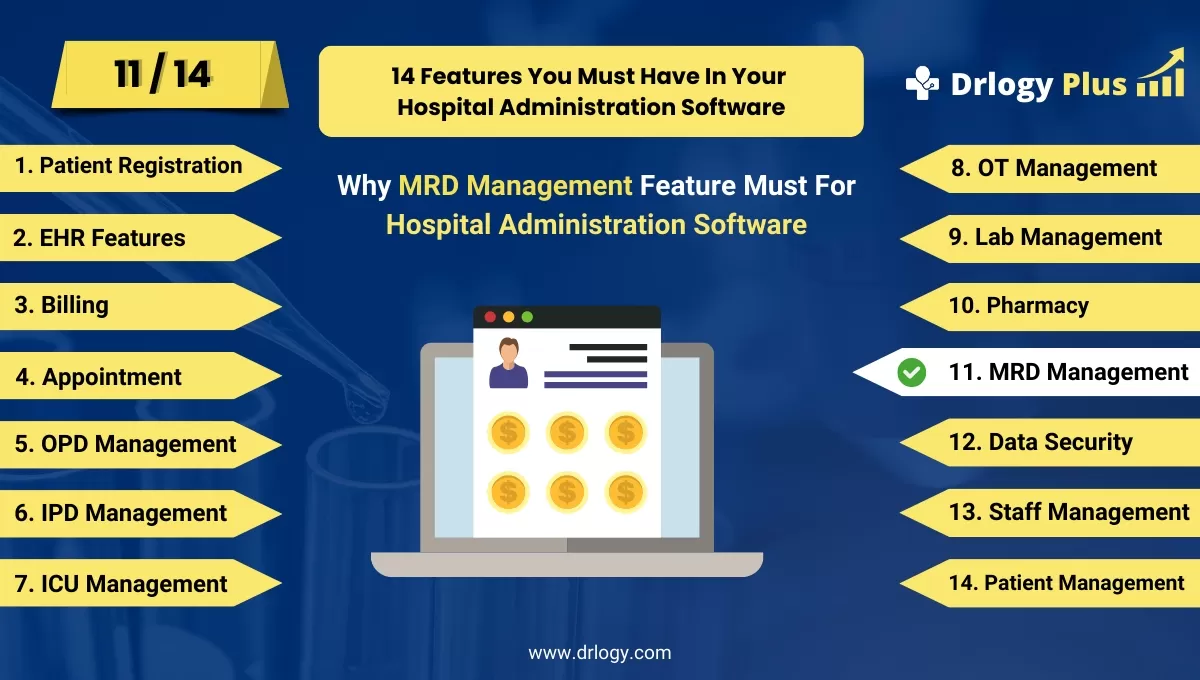
Drlogy Hospital Administration Software Features Guide For HMIS
Here are 14 Steps Drlogy Hospital Administration Software Features Guide For HMIS Selection.
| 1. Patient Registration | 8. OT Management |
| 2. EHR Features | 9. Lab Management |
| 3. Billing Management | 10. Pharmacy |
| 4. Appointment | 11. MRD Management |
| 5. IPD Management | 12. Data Security |
| 6. OPD Management | 13. Staff Management |
| 7. ICU Management | 14. Patient Management |
Summary
In summary, Integrating an MRD management feature in hospital administration software is essential for improving patient care, ensuring compliance, and enhancing overall hospital efficiency, leading to better outcomes and streamlined operations.
Explore the complete 14 steps Drlogy Hospital Administration Software guide for comprehensive insights into optimizing hospital operations and patient care.