Drlogy
Healthcare organization
10 Ways IPD Feature Enhances Gynecologist Software Workflow
IPD features are vital for tracking admitted patients, treatments, and recovery.
Check:
They ensure seamless inpatient care in gynecology clinics or hospitals.
10 Reasons Why IPD Feature Must for Gynecologist Software
Here are 10 compelling reasons why the IPD (In-Patient Department) feature is essential for gynecologist software.
1. Streamlines In-Patient Admission Process
- IPD modules simplify patient admission with digital entry of details like reason, room type, and attending doctor.
- Reduces paperwork and admission delays, improving patient experience.
- Tracks admission time, condition, and initial diagnosis accurately.
- Assigns beds, rooms, or wards efficiently with fewer manual errors.
- Speeds up the process for emergency or maternity admissions.
Quick and seamless admission through IPD ensures a smooth start to in-patient care.
2. Manages Bed and Room Allocation Efficiently
- Keeps real-time track of bed and room availability across the hospital or maternity ward.
- Helps in preventing overbooking or room conflicts during peak hours.
- Assigns private, semi-private, or general beds based on patient preference and availability.
- Enables proper occupancy planning for deliveries and post-op recovery.
- Improves space management and patient satisfaction.
IPD features help gynecologists manage maternity ward occupancy with clarity and control.
3. Facilitates Continuous Monitoring of Admitted Patients
- Records vital signs, nursing notes, doctor observations, and progress daily.
- Supports timely updates for conditions like labor progression or post-operative recovery.
- Allows gynecologists to track maternal and fetal health during hospitalization.
- Enables shift-wise updates from different healthcare staff for comprehensive care.
- Improves accuracy in clinical decisions with ongoing monitoring data.
Ongoing updates in the IPD module ensure better monitoring and safer care for in-patients.
4. Integrates with OT and Labor Room Management
- IPD connects seamlessly with the Operation Theater (OT) and labor room modules.
- Supports pre-operative and post-operative tracking for gynecological surgeries.
- Manages scheduling, anesthesia records, and surgical notes efficiently.
- Facilitates documentation of normal deliveries, C-sections, and related procedures.
- Keeps the clinical team coordinated across departments.
IPD integration with OT and labor rooms enhances coordination for critical gynecologic procedures.
5. Enables Accurate In-Patient Billing
- Automatically captures room charges, procedures, investigations, and medicines used during the stay.
- Reduces manual billing errors and improves transparency in patient charges.
- Generates consolidated or day-wise bills for insurance or discharge.
- Supports advance payments, refunds, and final settlements.
- Faster billing improves patient satisfaction at discharge.
IPD-linked billing ensures error-free, transparent invoicing for in-patient care.
6. Supports Multi-Department Collaboration
- Enables gynecologists to coordinate with anesthetists, pediatricians, dieticians, and nurses.
- All stakeholders can update and view patient data in real-time.
- Reduces miscommunication and ensures holistic care for mother and baby.
- Improves outcomes in complex maternity or surgical cases.
- Enhances communication efficiency within the hospital setup.
IPD software unites the entire care team to deliver coordinated and complete care.
7. Maintains Legally Compliant Documentation
- Captures consent forms, patient progress notes, lab results, and discharge summaries in one place.
- Provides audit-ready and medico-legal documentation.
- Supports digital signatures, printed forms, and patient tagging.
- Protects the doctor legally in case of any future claims or queries.
- Ensures documentation aligns with healthcare regulations.
IPD modules maintain secure, traceable records that meet legal and clinical standards.
8. Improves Discharge Planning and Summarization
- Helps schedule and document discharges with accurate summaries and instructions.
- Captures treatment details, test results, outcomes, and follow-up plans in discharge notes.
- Prepares discharge documentation with templates and doctor review.
- Improves patient satisfaction by speeding up discharge processing.
- Ensures continuity of care after discharge with clear post-hospital instructions.
Efficient discharge planning with IPD enhances care continuity and patient satisfaction.
9. Provides Insightful Reports and Analytics
- Generates reports on bed occupancy, admission trends, average length of stay, and procedures.
- Helps gynecologists and administrators improve resource planning and care delivery.
- Tracks outcomes of deliveries, surgeries, and complications.
- Assists inentifying recurring issues and improving quality of care.
- Empowers decision-making and performance tracking.
IPD reports help optimize operations, resources, and patient care with real-time data.
10. Enhances Overall Patient Satisfaction
- Smooth admission, consistent monitoring, accurate billing, and faster discharge improve patient experience.
- Real-time communication and transparency build trust in hospital systems.
- Better managed stays result in higher recovery rates and happier patients.
- Satisfied patients are more likely to return and refer others.
- Positive IPD experience boosts the clinic’s reputation and reviews.
A well-managed IPD system elevates the patient experience and strengthens clinic reputation.
Drlogy Gynecologist Software Features
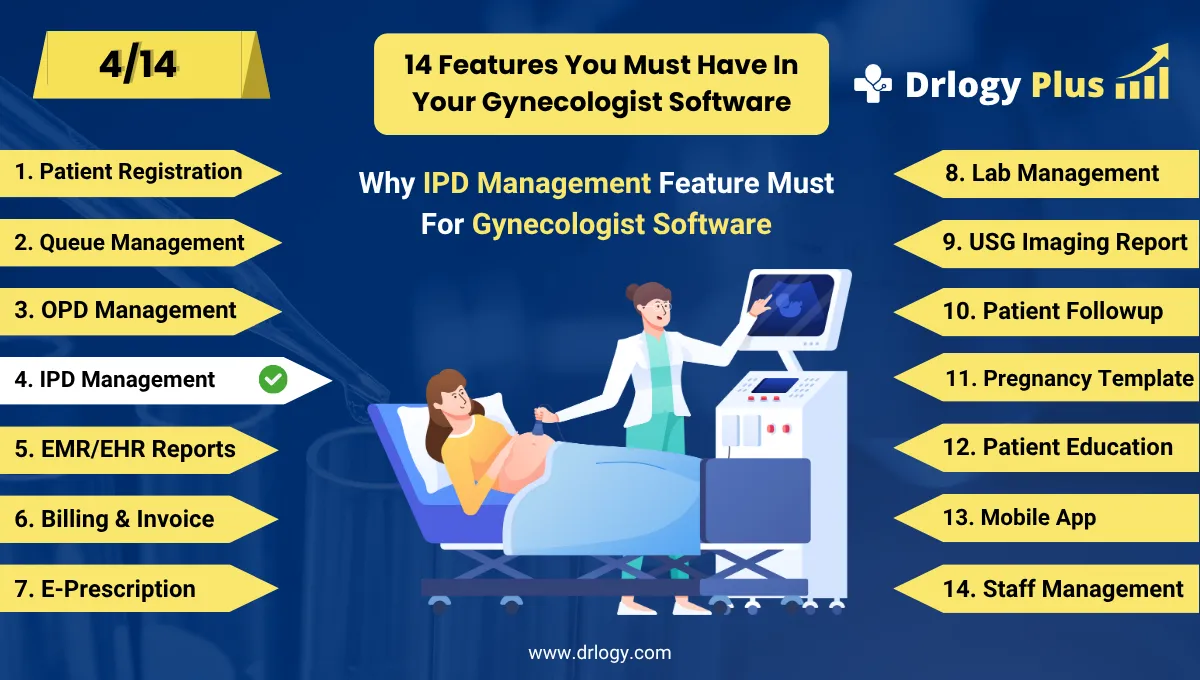
Here are 14 basic features for Drlogy Gynecologist Software.
| 1. IPD | 8. Lab Management |
| 2. Patient Queue Management | 9. USG & Imaging Report |
| 3. OPD Management | 10. Patient Followup |
| 4. IPD Management | 11. Patient Education |
| 5. EMR/EHR Reports | 12. Pregnancy Templates |
| 6. Billing & Invoice | 13. Mobile App |
| 7. Prescription Management | 14. Staff Management |
Summary
Overall, Robust IPD features guarantee seamless inpatient care and treatment tracking.
Check Drlogy Gynecologist Software Features Guide to streamline clinic workflows, improve patient management for pregnant women, and enhance overall efficiency in gynecology practice.