Drlogy
Healthcare organization
How IPD Management Feature Improves Gastroenterologist Software
Inpatient care plays a critical in managing serious gastrointestinal (GI) conditions like pancreatitis, gastrointestinal bleeding, liver cirrhosis, or post-endoscopic complications.
Check:
Best Gastroenterologist Software For Oncology Clinics & Hospitals
The IPD (In-Patient Department) feature in Gastroenterologist Software streamlines admission-to-discharge workflows, ensures accurate monitoring, and improves overall patient safety and hospital efficiency.
10 Ways IPD Feature Supports Gastroenterologist Software
Here are 10 Ways IPD Feature Supports Gastroenterologist Software.
1. Simplifies In-Patient Admission Process
- Digitally records admission details including diagnosis, ward, bed, and attending doctor.
- Supports planned or emergency admissions (e.g., GI bleeding, dehydration, or obstruction).
- Minimizes paperwork and manual errors during patient intake.
- Speeds up the process for emergency or post-procedure observation cases.
- Improves patient experience with smooth onboarding.
A well-structured IPD module ensures seamless in-patient admission and handover.
2. Manages Bed and Ward Allocation Effectively
- Tracks real-time bed occupancy across general, semi-private, and private wards.
- Reduces room conflicts, overbooking, and administrative delays.
- Automatically updates when patients are discharged or shifted.
- Optimizes resource utilization in gastro wards or ICU.
- Helps in managing surge periods during outbreaks or epidemics.
Efficient bed allocation reduces chaos and improves hospital capacity management.
3. Enables Continuous Patient Monitoring
- Logs vital signs, fluid balance, bowel movements, and nutrition input/output.
- Tracks daily doctor rounds, nursing notes, and medication charts.
- Allows gastroenterologists to monitor patient recovery trends in real-time.
- Improves clinical accuracy for complex GI cases (e.g., acute liver failure).
- Helps coordinate team-based interventions across shifts.
Consistent monitoring ensures safe recovery and timely interventions.
4. Connects with OT and Procedure Room Scheduling
- Schedules and manages endoscopies, colonoscopies, biopsies, or ERCP procedures.
- Tracks pre-operative and post-operative care for surgical GI cases.
- Maintains consent forms, anesthesia records, and intra-op notes.
- Coordinates between procedure teams and IPD staff seamlessly.
- Reduces delays and enhances clinical outcomes.
IPD and OT integration ensure procedural efficiency and continuity of care.
5. Generates Accurate In-Patient Billing
- Auto-captures room rent, procedure charges, medications, and diagnostics used.
- Supports package-based billing for GI procedures and treatments.
- Offers partial billing, final settlements, and insurance-ready documents.
- Reduces billing errors and improves financial transparency.
- Enhances patient trust during discharge.
Linked billing ensures full revenue capture and reduces disputes.
6. Supports Inter-Department Collaboration
- Enables real-time coordination with dietitians, radiologists, anesthetists, and intensivists.
- Allows documentation and review by all team members involved.
- Improves care quality in multi-disciplinary GI cases (e.g., malignancy, severe IBD).
- Reduces miscommunication and enhances treatment success.
- Encourages a team-based care model.
IPD unites care teams for more holistic gastroenterology treatment.
7. Ensures Legal and Clinical Documentation
- Stores admission notes, lab reports, prescriptions, and consent forms digitally.
- Maintains audit-ready, time-stamped records.
- Supports medico-legal case handling and regulatory compliance.
- Adds legal protection to both the hospital and physician.
- Useful for quality audits and insurance claims.
Digitally secure documentation reduces risks and meets compliance needs.
8. Improves Discharge Planning and Summaries
- Tracks discharge eligibility based on recovery milestones and doctor input.
- Prepares structured summaries with diagnosis, procedures, outcomes, and instructions.
- Sends discharge summaries to patients via app or email.
- Ensures continuity of care through post-discharge follow-up.
- Speeds up discharge process for better bed turnover.
A clear, professional discharge summary enhances patient satisfaction and post-care.
9. Generates Analytical Reports for IPD Metrics
- Tracks length of stay, admission frequency, outcome trends, and readmissions.
- Helps analyze procedure outcomes, antibiotic usage, and recovery durations.
- Supports internal audits and decision-making.
- Optimizes resource utilization and staff planning.
- Identifies bottlenecks and improves service quality.
IPD data insights help improve operational and clinical performance.
10. Boosts Patient Satisfaction and Trust
- Well-managed IPD stays lead to smoother care and recovery.
- Clear communication, transparent billing, and proactive follow-ups build confidence.
- Professionalism during in-patient care enhances the clinic or hospital’s reputation.
- Reduces complaints related to delays, miscommunication, or poor coordination.
- Increases patient referrals and online ratings.
Organized in-patient services elevate your brand’s image and patient loyalty.
Drlogy Gastroenterologist Software Features
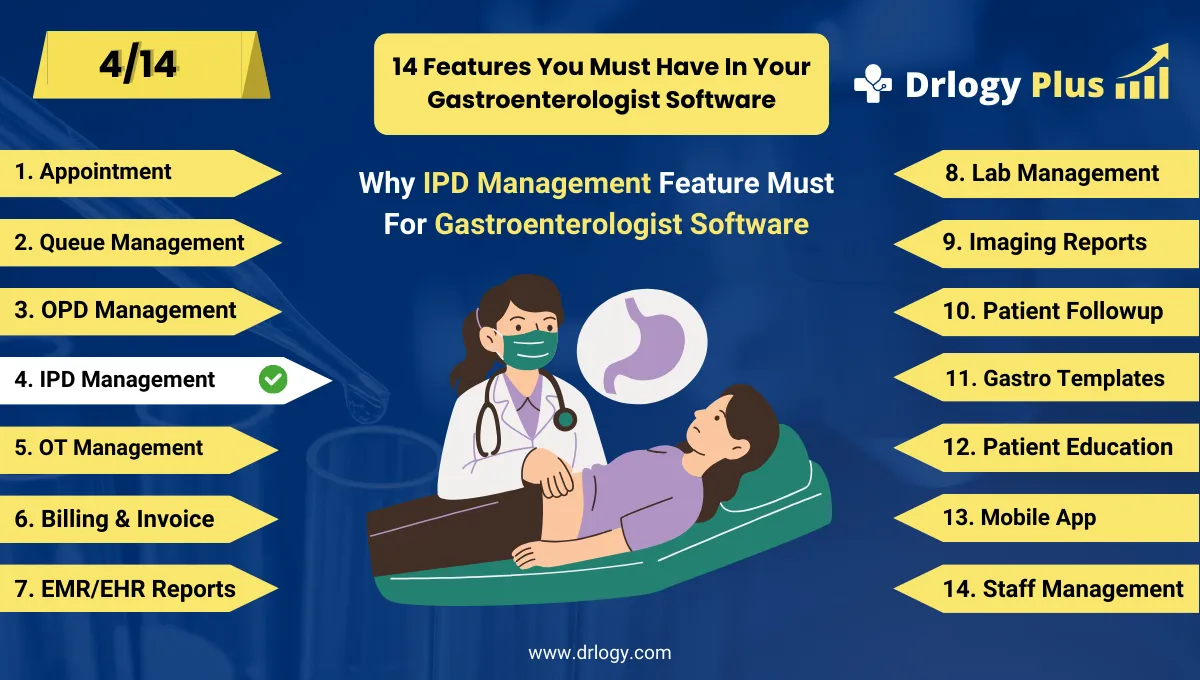
Here are 14 basic features for Drlogy Gastroenterologist Software.
Summary
Overall, IPD Feature in Gastroenterologist Software plays a vital in managing complex and acute GI conditions that require in-hospital care.
Check Drlogy Gastroenterologist Software Features Guide streamline gastroenterology clinic management, improve patient flow for digestiverelated conditions, and enhance overall efficiency in gastroenterology practice.