Drlogy
Healthcare organization
How Patient Registration Feature Enhances Oncologist Software
Oncology practices deal with highly sensitive, long-term, and complex care journeys.
Check:
A robust Patient Registration feature in Oncologist Software lays the foundation for structured, accurate, and personalized cancer treatment by capturing critical patient data right from the first visit.
10 Ways Patient Registration Helps Oncologist Software
Here are 10 Ways Patient Registration Helps Oncologist Software.
1. Captures Comprehensive Cancer History
- Records detailed family history, prior biopsies, tumor markers, and staging reports.
- Supports structured input of cancer type (breast, lung, colon, etc.) and histology.
- Provides baseline clinical context for treatment planning.
- Enables personalized care from Day 1.
- Helps oncologists assess hereditary risks or metastasis patterns.
A thorough registration process builds a complete picture of the patient’s cancer profile.
2. Streamlines New Patient Onboarding
- Speeds up administrative processes for first-time visits.
- Collects personal details, proofs, and insurance data in one go.
- Reduces paperwork and waiting time at reception.
- Improves the patient experience—especially important during emotional stress.
- Facilitates smooth entry into the cancer care system.
Efficient onboarding reduces anxiety and improves trust from the start.
3. Enables Accurate Appointment Scheduling
- Links registered patient data with oncologist or department-specific slots.
- Auto-maps patients to specialists based on cancer type (e.g., hematologist for leukemia, surgical oncologist for breast cancer).
- Avoids duplication of records and ensures correct doctor-patient assignment.
- Integrates with OPD, Daycare, or Chemotherapy schedules.
- Supports time-sensitive cancer care delivery.
Correct registration ensures timely access to the right oncologist.
4. Facilitates Treatment Cycle Planning
- Helps define protocols for chemotherapy, radiation, or immunotherapy.
- Patient type (new, follow-up, recurrence) can be tagged early.
- Supports multi-cycle care plans and ongoing treatment visibility.
- Helps in creating pre-consultation alerts or prep notes.
- Organizes complex case handling from the first encounter.
Accurate data at registration sets the stage for structured treatment planning.
5. Reduces Data Entry Errors
- Pre-set dropdowns and validation reduce manual mistakes.
- Ensures accurate spelling of drug allergies, tumor codes, or past surgeries.
- Captures accurate contact, emergency, and referral information.
- Supports reliable long-term EMR tracking.
- Improves clinical outcomes by avoiding misidentification.
Precision in registration ensures the right diagnosis is linked to the right patient.
6. Supports Multidisciplinary Team Coordination
- Registered details are accessible by surgical, radiation, medical oncologists, and palliative teams.
- Improves collaboration across departments for tumor boards.
- Shared access reduces data redundancy.
- Helps nurses, counselors, and lab technicians stay informed.
- Enhances team-based care across the patient’s cancer journey.
Shared access through registration improves integrated cancer care.
7. Enables Smart Follow-Up and Reminders
- Registration tags allow categorization by treatment stage, visit type, or risk level.
- Sends reminders for lab tests, scans, or follow-up consults.
- Helps reduce missed treatments or monitoring delays.
- Improves patient compliance with long-term cancer therapy.
- Ensures continuity in chronic or recurring cases.
Follow-up reminders improve survival outcomes and patient engagement.
8. Simplifies Billing and Insurance Processing
- Registration links patient data with billing modules.
- Enables package-based pricing (e.g., chemotherapy cycles, radiation sessions).
- Supports third-party payer and insurance validations.
- Prevents billing mismatches or patient confusion.
- Reduces delays in claims and reimbursements.
Smooth registration helps manage cancer care costs transparently and efficiently.
9. Supports Analytics and Cancer Registry
- Captures structured oncology-specific data at entry.
- Enables easy export to regional or national cancer registries.
- Assists in audit, accreditation, and research programs.
- Tracks disease trends, patient outcomes, and recurrence rates.
- Empowers improvements in cancer care.
Accurate registration fuels long-term research and reporting in oncology.
10. Enhances Emotional and Personalized Care
- Collects details about support system, caregiver contacts, or preferred communication.
- Enables empathetic, personalized interactions from the start.
- Notes psychological or palliative needs early on.
- Helps assign counselors or social workers during treatment.
- Builds trust and comfort during a difficult health journey.
Patient-centered registration humanizes the cancer care experience.
Drlogy Oncologist Software Features
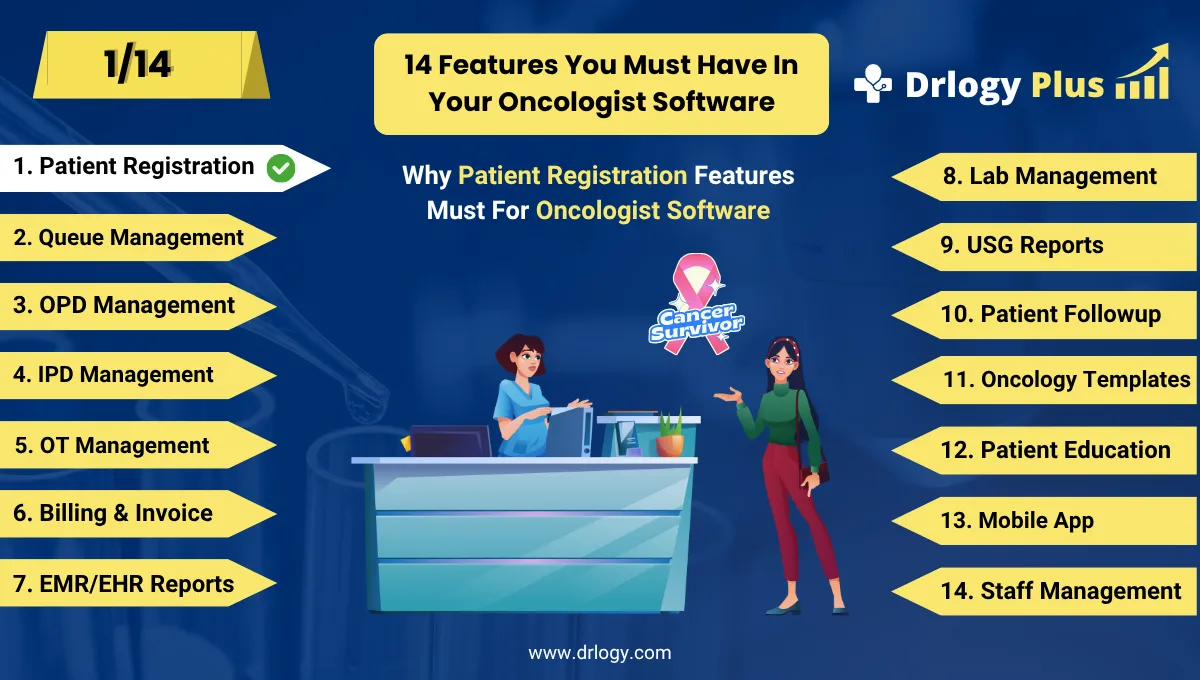
Here are 14 basic features for Drlogy Oncologist Software.
Summary
Overall, The Patient Registration feature in Oncologist Software is more than just an administrative step—it is the clinical starting point for effective, safe, and compassionate cancer care.
Check Drlogy Oncologist Software Features Guide streamline cardiology clinic management, improve patient flow for cancer related conditions, and enhance overall efficiency in oncology practice for cancer patient.