Drlogy
Healthcare organization
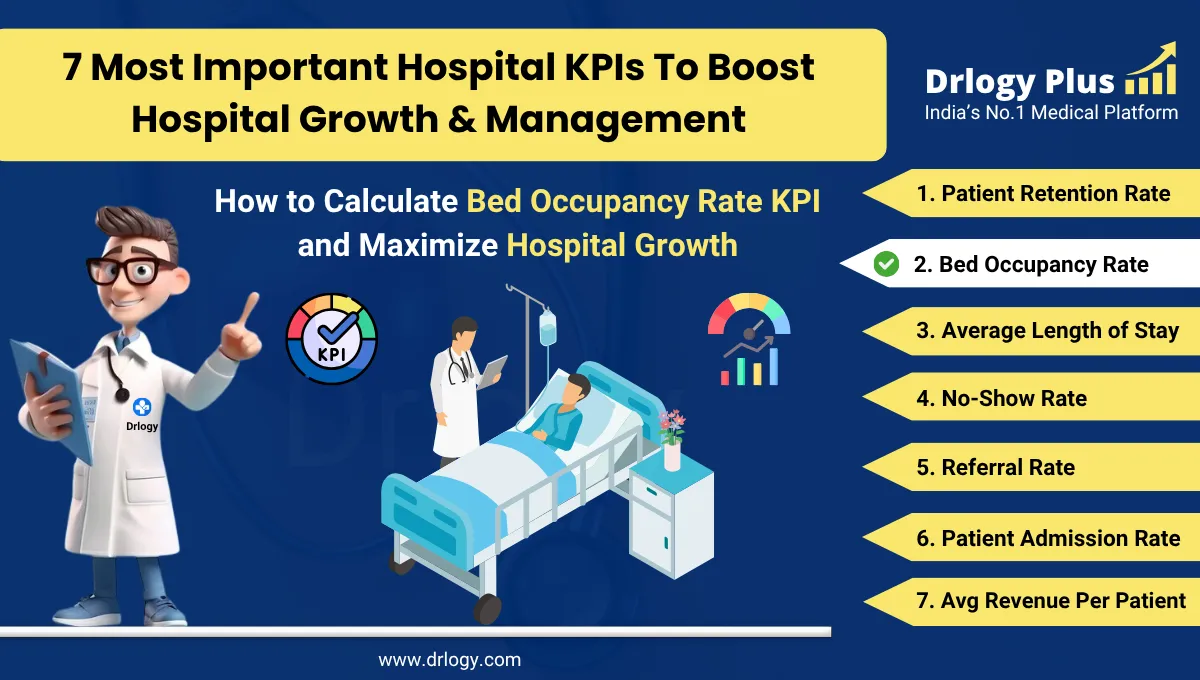
How to Calculate Bed Occupancy Rate KPI and Maximize Hospital Growth
When it comes to running a hospital efficiently, managing capacity is just as important as providing high-quality care.
Check:
The Bed Occupancy Rate (BOR) is a key metric thatectly impacts hospital performance, growth, and profitability. A well-balanced BOR ensures optimal use of hospital resources, increases revenue, and improves overall patient care.
What is Bed Occupancy Rate KPI
Bed Occupancy Rate (BOR) is a metric that reflects the percentage of occupied beds in a hospital compared to the total available beds over a given period.
- This KPI helps healthcare facilities track the utilization of their bed capacity, which is a vital indicator of operational efficiency.
- A high BOR suggests that the hospital is effectively managing patient flow, minimizingle bed capacity, and making the most of its resources.
- Conversely, a low BOR might indicate underutilized resources or a need for better patient outreach to ensure optimal bed occupancy.
- Monitoring and optimizing BOR can lead to improved patient care, better financial performance, and long-term growth for hospitals.
How Bed Occupancy Rate KPI Scientifically Works
Bed Occupancy Rate isectly linked to a hospital’s ability to manage both patient demand and available resources. The KPI works by calculating the ratio of occupied beds to total available beds over a specific time frame.
Several factors contribute to BOR:
- Patient Admission Rate: Higher admission rates lead to more occupied beds and a higher BOR.
- Discharge Planning: Efficient discharge protocols ensure that patients vacate beds promptly, allowing other patients to be admitted.
- Hospital Marketing: Effective marketing strategies can drive more patient admissions, leading to higher BOR.
- Patient Flow Management: Streamlining the patient journey from admission to discharge helps maximize bed usage.
By improving these factors, hospitals can ensure that their BOR remains optimal, leading to better financial outcomes and improved patient care.
Bed Occupancy Rate KPI Formula
Here is the basic formula to calculate Bed Occupancy Rate.
Bed Occupancy Rate (%) = (Total Patient Bed Days / Total Available Bed Days) × 100
Bed Occupancy Rate KPI Result
| Bed Occupancy Rate (%) | Interpretation |
|---|---|
| 85% - 100% | Optimal occupancy; efficient resource utilization but may risk overcrowding. |
| 70% - 84% | Ideal balance between efficiency and availability. |
| 50% - 69% | Moderate occupancy; potential underutilization of resources. |
| Below 50% | Low occupancy; indicates inefficiency or low patient influx. |
How to Calculate Bed Occupancy Rate KPI
Use the simple formula:
Bed Occupancy Rate (%) = (Total Patient Bed Days / Total Available Bed Days) × 100
Steps to Calculate:
- Determine Total Patient Bed Days: Count the total number of occupied bed days in a given period.
- Identify Total Available Bed Days: Multiply the number of beds by the number of days in the period.
- Apply the Formula: Divide occupied bed days by available bed days, then multiply by 100.
Example:
A hospital with 200 beds records 5,400 occupied bed days in a month (30 days).
Bed Occupancy Rate = (5,400 / (200 × 30)) × 100 = (5,400 / 6,000) × 100 = 90%
This means the hospital operates at a 90% occupancy rate, indicating optimal resource utilization.
Bonus Tools For Hospital Marketing:
Why Bed Occupancy Rate KPI is a Crucial Metric for Hospitals
The Bed Occupancy Rate is a crucial metric for hospitals for several reasons:
- Revenue Maximization: A higher BOR means that more beds are occupied, leading to higher revenue generation. Optimizing this KPI ensures that the hospital is fully utilizing its available resources.
- Cost Efficiency: Hospitals that maintain a high BOR can distribute fixed operational costs (such as staffing and infrastructure) over a larger patient base, improving cost efficiency.
- Better Patient Care: When BOR is optimized, hospitals have the resources to deliver timely care to patients without overcrowding. This leads to higher patient satisfaction and better overall care.
- Operational Efficiency: A hospital with a well-managed BOR can improve its operational workflows, minimizing delays in patient admissions and discharges, and optimizing the use of medical equipment.
- Strategic Expansion Planning: Tracking BOR allows hospitals to assess the need for expansion or contraction in terms of bed capacity. Hospitals can plan for future growth based on trends in BOR.
By maintaining an optimal BOR, hospitals can ensure that they operate at peak efficiency, drive revenue growth, and maintain a high level of patient care.
Bed Occupancy Rate KPI Benefits
- Optimized Resource Utilization – Ensures hospital beds, staff, and facilities are efficiently used, reducing operational waste.
- Enhanced Financial Performance – A higher occupancy rate leads to better revenue generation and financial stability for hospitals.
- Improved Patient Flow Management – Helps in planning admissions, discharges, and resource allocation for better patient care.
- Capacity Planning & Expansion – Provides insights for hospital expansion, infrastructure improvements, and resource allocation.
- Better Healthcare Quality & Efficiency – Encourages hospitals to improve turnaround times and reduce unnecessary delays in patient care.
Improving Bed Occupancy Rate KPI in Hospitals: Actionable Strategies
To maximize the Bed Occupancy Rate KPI and drive growth, hospitals can implement the following strategies:
- Streamline Admissions: Hospitals should have a well-established process for admitting patients efficiently. Minimizing wait times and optimizing patient intake can help maintain a steady flow of patients.
- Efficient Discharge Planning: Hospitals can improve BOR by ensuring timely discharges. This can be achieved by setting clear discharge plans and follow-up schedules for patients.
- Enhance Marketing Efforts: Hospitals should invest in marketing strategies to attract more patients and increase demand for their services. Digital marketing campaigns, community outreach programs, and patient referral systems can help boost BOR.
- Optimize Patient Flow: Efficient patient flow, from admission to discharge, ensures that beds are utilized optimally. Hospitals can enhance patient care coordination by implementing healthcare management software, which streamlines scheduling, treatment, and discharge.
- Expand Services: Offering new services or specialty care options can attract more patients and increase BOR. Hospitals that cater to specific patient needs often see higher occupancy rates as they become known for their unique expertise.
How Hospitals Can Use Bed Occupancy Rate KPI to Boost Overall Growth
The Bed Occupancy Rate is a crucial metric for hospitals for several reasons:
- Revenue Maximization: A higher BOR means that more beds are occupied, leading to higher revenue generation. Optimizing this KPI ensures that the hospital is fully utilizing its available resources.
- Cost Efficiency: Hospitals that maintain a high BOR can distribute fixed operational costs (such as staffing and infrastructure) over a larger patient base, improving cost efficiency.
- Better Patient Care: When BOR is optimized, hospitals have the resources to deliver timely care to patients without overcrowding. This leads to higher patient satisfaction and better overall care.
- Operational Efficiency: A hospital with a well-managed BOR can improve its operational workflows, minimizing delays in patient admissions and discharges, and optimizing the use of medical equipment.
- Strategic Expansion Planning: Tracking BOR allows hospitals to assess the need for expansion or contraction in terms of bed capacity. Hospitals can plan for future growth based on trends in BOR.
By maintaining an optimal BOR, hospitals can ensure that they operate at peak efficiency, drive revenue growth, and maintain a high level of patient care.
Key Performance Indicators (KPIs) Linked to Patient Retention
- Net Promoter Score (NPS) – Measures patient satisfaction and their likelihood of recommending the hospital to others,ectly impacting retention.
- Patient Satisfaction Score – Evaluates patient experiences based on feedback, helping hospitals improve care quality and increase retention rates.
- Patient Referral Rate – Tracks the percentage of new patients acquired through existing patient recommendations, indicating strong patient loyalty and trust.
Benchmarking Bed Occupancy Rate KPI: What Hospitals Should Aim For
- Hospitals should aim for an optimal BOR of 50% to 80%.
- This range ensures that the hospital is fully utilizing its resources without overcrowding, allowing for efficient operations and the delivery of high-quality care.
- Monitoring BOR regularly will help hospitals make necessary adjustments to their capacity and operations.
The Future of Bed Occupancy Rate KPI: Trends to Watch
- The future of Bed Occupancy Rate KPI is set to be influenced by technological advancements and predictive analytics.
- Hospitals that incorporate AI and machine learning will be able to predict patient flow trends, optimize bed management, and improve patient care, leading to even higher BOR and hospital growth.
Drlogy Hospital KPIs Guide
Here are 7 important Drlogy Hospital KPIs Guide.
| Hospital KPI |
|---|
| 1. Patient Retention Rate |
| 2. Bed Occupancy Rate |
| 3. Average Length of Stay (ALOS) |
| 4. Appoinment No-Show Rate |
| 5. Referral Rate |
| 6. Patient Admission Rate |
| 7. Average Revenur Per Patient (ARPP) |
Summary
Overall, Overall, optimizing Bed Occupancy Rate is critical for hospital growth. By maintaining a high BOR, hospitals can increase revenue, improve resource management, streamline operations, and enhance the patient experience.
Check Drlogy Hospital KPIs Guide to unlock key metrics that drive hospital growth, enhance patient care, and improve overall hospital performance.