Drlogy
Healthcare organization
How to Calculate Average Revenue Per Patient (ARPP) KPI For Hospital Growth
Average Revenue Per Patient (ARPP) is a crucial financial KPI that measures the average revenue a hospital or healthcare facility generates per patient visit or admission.
Check:
This metric helps hospitals evaluate their financial performance, optimize pricing strategies, and improve overall service profitability.
What is Average Revenue Per Patient (ARPP) KPI
ARPP indicates how much revenue a hospital earns per patient on average.
- It reflects the effectiveness of pricing strategies, service quality, and revenue diversification.
- A higher ARPP suggests that the hospital is efficiently utilizing its resources and offering value-added services to enhance revenue generation.
How Average Revenue Per Patient (ARPP) KPI Scientifically Works
- Revenue Efficiency – Measures how effectively a hospital converts patient visits into revenue.
- Service Utilization – Tracks how well hospitals optimize their services to increase per-patient earnings.
- Financial Sustainability – Helps hospitals assess profitability and financial health over time.
Average Revenue Per Patient (ARPP) KPI Formula
Here is the basic formula to calculate Average Revenue Per Patient (ARPP):
ARPP = Total Revenue / Total Number of Patients
Average Revenue Per Patient (ARPP) KPI Result
| ARPP Value | Interpretation |
|---|---|
| High ARPP | Indicates strong revenue generation per patient, possibly due to premium services or effective billing strategies. |
| Moderate ARPP | Suggests balanced revenue, with opportunities for optimization through better service offerings. |
| Low ARPP | May indicate underutilized revenue opportunities or pricing issues, requiring financial strategy improvements. |
How to Calculate Average Revenue Per Patient (ARPP) KPI
Use the simple formula:
ARPP = Total Revenue / Total Number of Patients
Steps to Calculate:
- Determine Total Revenue – Sum up all revenue generated from patient services within a specific period.
- Identify Total Number of Patients – Count the total number of patients served in the same period.
- Apply the Formula – Divide Total Revenue by Total Number of Patients to get the ARPP value.
Example:
A hospital generates Rs 20,00,000 in revenue in a month and serves 500 patients during that period.
ARPP = 20,00,000 / 500 = Rs 4000
This means the Average Revenue Per Patient (ARPP) is Rs 4000, indicating the hospital earns Rs 4000 per patient on average.
Bonus Tools For Hospital Marketing:
Why Average Revenue Per Patient (ARPP) KPI is a Crucial Metric for Hospitals
- Measures Hospital Profitability – Helps track financial performance over time.
- Optimizes Pricing Strategies – Provides insights into service pricing and revenue potential.
- Enhances Service Offerings – Encourages hospitals to introduce value-added services for better revenue.
Average Revenue Per Patient (ARPP) KPI Benefits
- Improved Financial Planning – Helps hospitals allocate resources efficiently.
- Better Revenue Diversification – Encourages hospitals to expand services and optimize revenue streams.
- Enhanced Patient Care Strategies – Drives investment in high-quality services that boost revenue.
Improving Average Revenue Per Patient (ARPP) KPI in Hospitals: Actionable Strategies
- Optimize Service Pricing – Review and adjust pricing models based on market trends and patient affordability.
- Increase Value-Added Services – Introduce specialized treatments, wellness programs, and premium services.
- Enhance Patient Retention – Implement loyalty programs and follow-up care to encourage repeat visits.
How Hospitals Can Use Average Revenue Per Patient (ARPP) KPI to Boost Overall Growth
Hospitals can leverage ARPP insights to refine pricing models, expand high-revenue services, and improve financial sustainability. By continuously monitoring ARPP, hospitals can enhance service quality while maximizing profitability.
Key Performance Indicators (KPIs) Linked to Patient Retention
- Patient Retention Rate – Measures how well hospitals maintain long-term patient relationships.
- Bed Occupancy Rate – Tracks how efficiently hospital beds are utilized.
- Patient Admission Rate – Evaluates how many patients are admitted for inpatient ca
The Future of Average Revenue Per Patient (ARPP) KPI: Trends to Watch
- AI & Data Analytics – Hospitals are using AI to analyze patient spending patterns and optimize service pricing.
- Telemedicine & Digital Health – Virtual consultations and remote care services are increasing ARPP potential.
- Subscription-Based Healthcare Models – Membership plans and preventive care programs boost revenue per patient.
Drlogy Hospital KPIs Guide
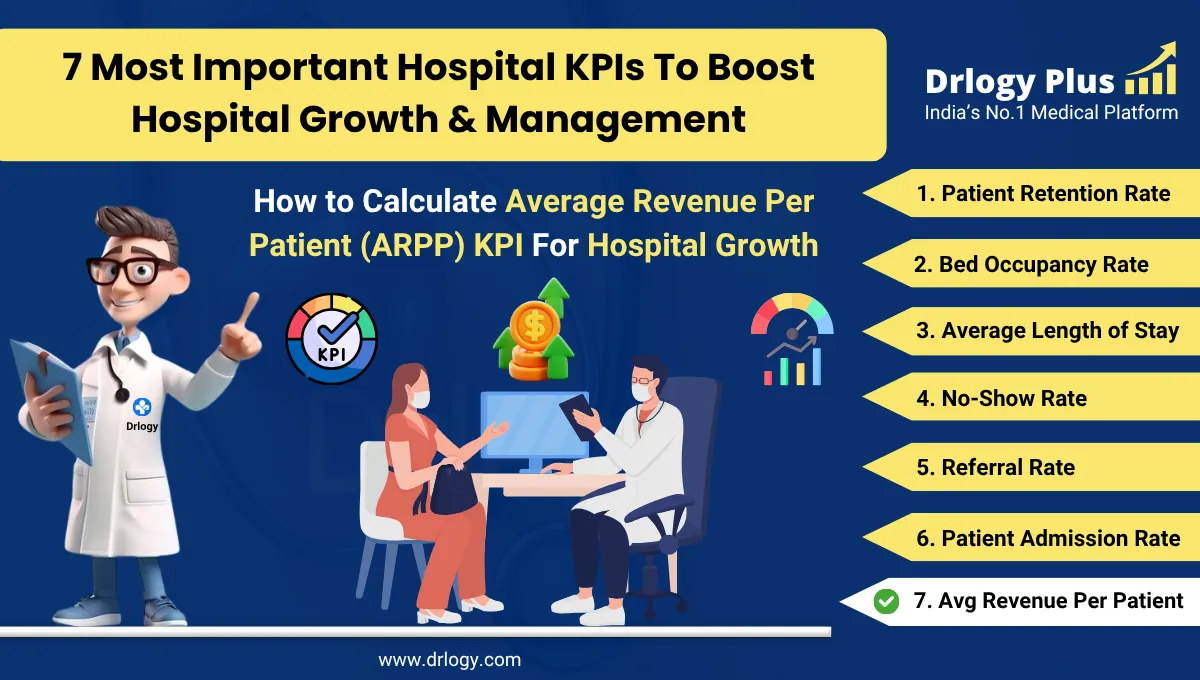
Here are 7 important Drlogy Hospital KPIs Guide.
| Hospital KPI |
|---|
| 1. Patient Retention Rate |
| 2. Bed Occupancy Rate |
| 3. Average Length of Stay (ALOS) |
| 4. Appoinment No-Show Rate |
| 5. Referral Rate |
| 6. Patient Admission Rate |
| 7. Average Revenur Per Patient (ARPP) |
Summary
Overall, Tracking Average Revenue Per Patient (ARPP) KPI is essential for hospitals aiming to improve financial stability, optimize pricing, and enhance service quality.
Check Drlogy Hospital KPIs Guide to unlock key metrics that drive hospital growth, enhance patient care, and improve overall hospital performance.