Drlogy
Healthcare organization
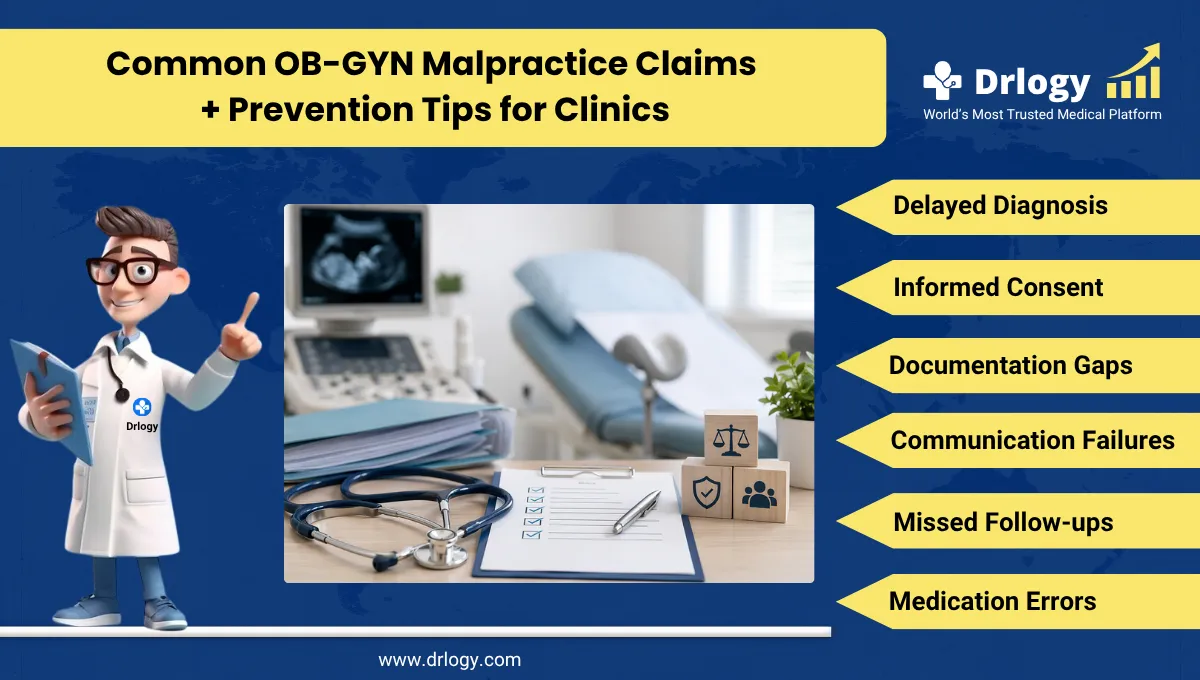
Common OB-GYN Malpractice Claims + Prevention Tips for Clinics
OB-GYN Malpractice Claims. Why They Happen, and How to Prevent
OB-GYN claims have wildly disproportionate financial weight vs many other specialties. Obstetrics represents a small proportion of closed claims, but it ranks consistently in the highest categories for paid claims and for large indemnity amounts. The stakes sound scary, and seemingly make these claims inevitable. But these claim types follow predictable patterns and can be prevented.
Most claims do not come from intentional recklessness; instead, like most adverse events, they stem fromentifiable system failures, such as poor communication during handoffs, unclear criteria for what needs to be escalated, follow-up processes that depend on human memory, and documentation practices that don't capture clinical reasoning. When a clinic approaches this as a problem for system design, rather than individual perfection, it creates safety for both patients and providers.
Here are 6 different types of OB-GYN claims, and the operations systems you can build to lower them.
Why OB-GYN Claims Happen (and Why They Are Mostly Systems-Level Prevention)
Malpractice and operational risk are rarely about a “bad clinician” safety research typically describes the following categories:
- Active failures — the unsafe act that reaches the patient (e.g., a missed result, delayed med, or misunderstood order).
- Latent conditions — the “resident” system problems that increase the likelihood of active failures (unclear policies, trips and falls, understaffing, bad workflows, inconsistent supervision/oversight, or tools that don't support the way the team operates).
In other words, the last mistake is the visible one, but rarely the only one.
Operational prevention reduces the likelihood of a claim; malpractice insurance reduces the damage when one still happens. The strongest approach pairs systems that prevent errors (clear policies, reliable handoffs, staffing plans, escalation pathways) with OB-GYN malpractice coverage that funds the legal defense and helps pay settlements or judgments within the policy limits. In other words: prevention is the first line of protection, and malpractice insurance is the backstop when prevention isn’t enough.
It’s also critical to name the non-technical dimension of communication and relationship quality. Patients are less likely to sue clinicians who are respectful, empathetic, and professional even if the end results are bad or errors are made. This doesn't mean try to be nice and you'll be immune. Rather, it argues for communication and behaviors, particularly in escalated interactions, to be treated as clinical infrastructure just like the rest of the mandatory training. These are core skills, not optional enhancements.
Claim #1 Delayed Diagnosis, or Failure to Act on Red Flags
Delayed diagnosis claims follow a common script: there were warning signs that were normalized, misplaced during triage, and not escalated in a timely fashion. Time-sensitive conditions common in obstetrics, like sepsis, severe hypertension, hemorrhage, ectopic pregnancy, and others, are particularly prone to the “looks okay for now” attitude, until things rapidly deteriorate.
Preventative strategies include replacing provider vigilance with systems that provide clear triggers and pathways:
- Standardized triage pathways that include defined physiologic criteria (not “provider judgement only”) for escalation. For example, what vital sign thresholds (and other findings) require notification and concern?
- Clear triggers for escalation based on cutoffs specified by who is responsible for executing the next step (rechecking vitals, labs, bedside assessment, consult, transfer to higher level of care, etc.).
- Critical result notification with closed-loop confirmation, not passive inbox delivery or a “notification is in the chart” attempt. Closed-loop confirmation of critical results along with assignment and documentation of the next step(s).
- Time-based targets for emergencies where minutes count (like severe-range blood pressures incidents) along with workload targets to make them achievable even during peak volume.
Claim #2 Inadequate Informed Consent
Informed consent claims often come from inadequate disclosure and incomplete documentation of risks, benefits, alternatives, and the fundamental why/how of the plan of care. Not just off-label or contraindicated interventions, but also general discussions for any negative outcome that would change the plan. The inadequacy isn't about whether a checkbox was signed on a form, but whether the disclosure was adequate. Written patient materials help, but rarely replace the conversation.
Strategies to improve consent defensibility and patient understanding include:
- Use of teachback ask the patient to explain back the plan in their own words, including risks, alternatives, what to watch for, and what would change the plan. Then correct.
- Teachback of the emergency vs nonemergency status so that childbirth is considered the risky it is, but not an emergency that overrides patient autonomy like true emergencies should.
- Inadequate documentation of consent as a problem — not just checkbox but specifically the appropriate specifics for the actual procedure (C-section vs induction vs operative vaginal delivery) and alternatives for the actual procedure, not a generic “R/B/A”.
Claim #3 Documentation Gaps (The Chart Doesn’t Match Care Provided)
From a legal perspective, documentation acts as the clinician's remote memory, particularly when claims may be filed years after an event. It's common to see documentation that captures the “what” but fails to explain the “why” clinical decisions were made.
Additional nuances with modern EMRs, the medical record includes metadata like timestamps, authorship, and edits. Inconsistencies between narrative notes and the activity history can raise questions.
Concrete documentation upgrades:
- Document the “why” not just the “what”, linking symptoms, vitals/fetal tracing interpretation, labs, imaging, and consult input to the management decisions they inform.
- Document inherent risk versus patient-specific increased risk for procedures and interventions — “bleeding” as inherent, but “bleeding risk increased due to X” to show individualized decision making.
- Use the “handoff” mental model — the common practice of transferring care to another clinician via a note/intented communication. What is the current assessment, the rationale, what to watch for, and what to do if the patient deteriorates?
Claim #4 Communication/Handoff Failures
Obstetrics-related claims commonly stem from communication failures, particularly during transitions in care. This includes shift changes, crosscoverage, transfers between inpatient/observation/triage settings, and escalation from outpatient clinics to triage/inpatient contexts.
Perception mismatches also erroneously contribute — people can agree on what's said/done, but disagree on the tone or intent. If people feel disrespect, or try to avoid conflict, they may be less vocal and this creates gaps in care.
Standards to make communication reliable via structured handoffs and standardized communication include:
- SBAR/I-PASS handoffs with required structure, so that under stress, nothing critical is omitted.
- Closed-loop verification when orders/escalations are made requires repeat-back/paraphrase and confirmation. This is particularly needed for urgent items.
- Briefs/huddles/debriefs are short and routine team touchpoints that communicate intentions and realigns, contingencies, and plans after high acuity events.
Claim #5 Missed Followup (Labs, Pathology, Missed ED/Triage Followup, Postpartum Gaps)
Claim types that involve missed followup are common but often operational in nature, not clinical knowledge issues. Scenarios include missed critical labs/pathology, ED followup of triage care, and occasional gaps in postpartum care, especially for hypertension and other risk conditions. Modern care views the postpartum period not a single 6-week visit, but as continuous care that requires tighter followup especially for high-risk patients.
Operational systems to make this more reliable:
- Scheduling follow-up before discharge if blood pressure checks or other critical labs should happen within a timeframe, it should be scheduled ahead.
- Standardization of Pregnancy of Unknown Location (PUL) protocols with rates of repeat testing and ultrasound expected, explicit return precautions, and documented instructions on accessing urgent care.
- Inbox/Results ownership and coverage of a named individual for results review/coverage/updating of the inbox to be triaged if needed, but a trail of “pending results” is communicated and tracked. It can’t rely on human memory.
- No-show rescue ladder attempts by phone/portal outreach/and occasional certified letter when appropriate, to ensure higher reliability on followup.
Claim #6 Medication Errors
Medication and prescribing related claims in OB/GYN frequently involve dosing errors, interactions, unclear instructions, counseling gaps for cardiac meds, and errors related to pregnancy or lactation considerations.
Two systems drive most reductions in prescribing errors:
- Decision support at the time of prescribing order entry and interaction/allergy checks, with a standard of care on high alert meds ordering.
- Standardization and simplification of medication usage, standard concentrations and order sets, standard medication protocols, and default workflows reduce variation, which otherwise causes documented errors.
- Lactation counseling should not be assumed analogous to pregnancy/lactation usage and similarly counseling and documentation should be consistent for lactation with scripts to describe expected side effects and what to watch for in the infant and when to call.
10 Minute OB-GYN Risk Reduction Audit
Checklists are cognitive “nets” to make sure operations get done, even for expert clinicians in chaotic high-stress settings.
Here’s a quick audit that can be used toentify bunches of high yield gaps:
- Is there triage escalation with clear physiologic cues for immediate notification?
- Is there time to treatment standards, with tracking and review of the overall workflow (not blaming individual clinicians) available?
- Is there closed loop critical lab/imaging notifications, with a documentation of the next steps?
- Is consent well documented with teachback or similar, not just a checkbox?
- Is handoffs structured with SBAR/I-PASS?
- Is there near miss reporting and collection/analysis toentify vulnerabilities before harms occur?
- Is there an insurance “scope check” to match current services, locations, call coverage, and any expanded procedures?
Quick Insurance Basics for Clinic Owners
Even strong prevention programs in medicine cannot fully eliminate the occurrence of claims, and clinic owners should be aware of a few key mechanics related to coverage which can impact defense costs, tail periods, and effective insurance coverage both in OB-GYN and other medicine specialties:
Occurrence vs claims made: Occurrence type coverage generally follows the date of the medical event, and claims made generally follows the date the claim is reported while the policy is live.
Tail coverage (extended reporting period): If you leave a claims made policy, usually this is what happens so you're not screwed.
Defense costs inside or outside limits: Defense costs can add substantial $ costs even when you ultimately win, so confirm this.
If you want a centralize this part of the risk plan, then OB-GYN malpractice insurance should be considered along with clinical operations. As a protection when prevention is not enough. And as an optional thing to do.
Next Steps: Turn Prevention into Routine, Not Reaction
The strongest clinics do not rely on heroic memory and individual judgment in high stress situations. They proactively build systems where the right thing is the default, and revisit those systems before negative events happen. A few simple ways to turn this article into operational strategy a quick audit:
- Pick 2 “can't miss” workflows to standardize this month. Common high-yield examples include severe range blood pressure response, sepsis escalation, critical lab notification, post partum HTN followup etc etc.
- Status ownership for all high risk crosscoverage / handoffs (eg if results come in for a lab/pathology/referral/postpartum check, and it's pending, an individual ownership (and backup) should be assigned).
- Audit a few charts a quarter. High acuity triage, delivery, procedures, and postpartum complications. Are there clear escalation triggers, consent communication, and clinical reasoning documented?
- Debrief both misses and near misses in a non blame fashion. Latent conditions (staffing, unclear policies, tools, competing priorities) cause these, let's fix it.
- Align insurance coverage with the real practice. As scope changes, coverage locations, call responsibilities, etc this often leads to otherwise overlooked insurance issues that become a clinic threat.
Conclusion
Strong systems -not memory-prevent most OB-GYN errors. Standardize workflows, communication, and follow-ups to reduce risk.
Prevention first, insurance second. Together, they protect clinics, improve outcomes, and build patient trust.