Drlogy
Healthcare organization
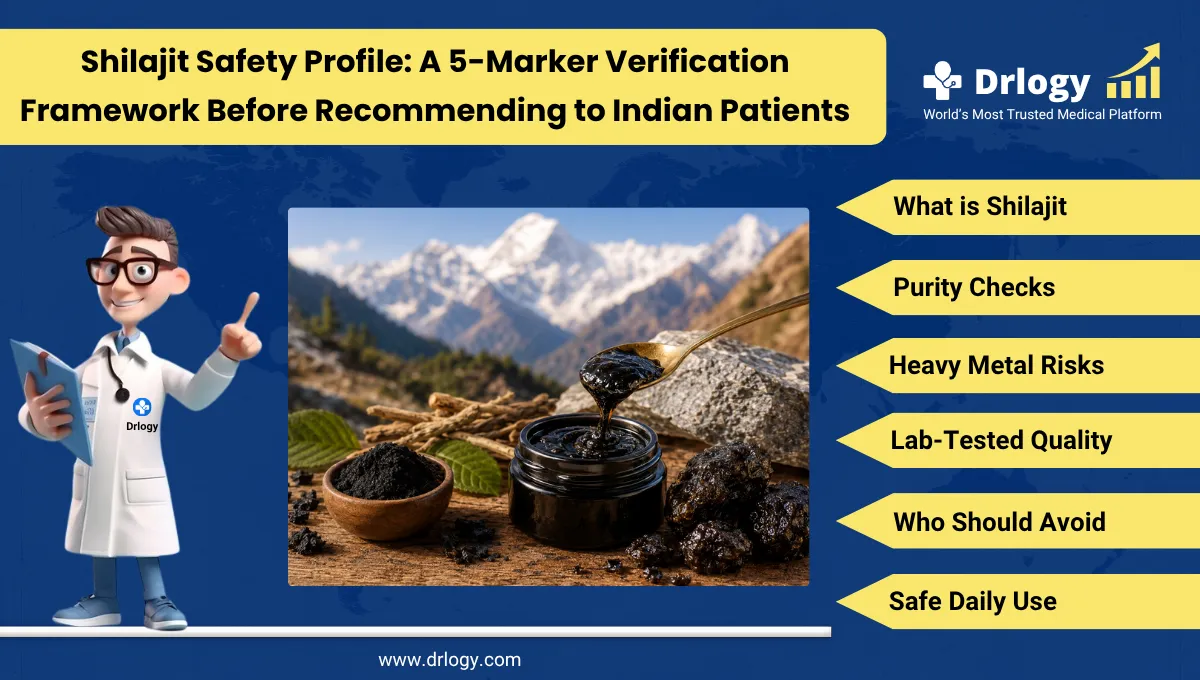
Shilajit Safety Profile: 5-Marker Verification Framework
What is Shilajit?
Shilajit (Sanskrit: Shilajatu — meaning “rock-invincible”) is a natural resin that oozes from rock fissures in the Himalayan ranges between 16,000 and 18,000 feet. Classical Ayurveda lists it among the most important Rasayana (rejuvenative) substances, with a documented therapeutic history of over 3,000 years across Charaka Samhita and Sushruta Samhita.
Modern chemistry identifies its principal bioactive as fulvic acid — a low-molecular-weight humic substance that classical texts described as Yogavahi, the “carrier” that transports trace minerals across cellular membranes. Sanskrit clinical wisdom and modern bioavailability science are saying the same thing in different words.
For a 2026 Indian clinician, the question is no longer “does shilajit work?” — there is reasonable evidence for specific indications. The question is: which brand is safe enough to recommend to my patient?
This article gives you a 5-marker framework to answer that confidently in 90 seconds.
Why Indian Clinicians Need This Framework Right Now
In my clinical practice as an Ayurvedic Physician (BAMS, MD Ayurveda), shilajit-related questions have moved into the top three supplement queries in Indian outpatient consultations in 2026, alongside ashwagandha and turmeric extracts. Patients walk in with brand bottles and ask “Doctor, is this safe for me?”
The market reality:
- Indian shilajit market growth: 35–45% CAGR since 2021
- NABL-accredited testing infrastructure growth: ~10–15% in the same period
- Result: A widening gap where adulteration, heavy-metal contamination, and product misidentification live
This gap is medico-legal exposure for any clinician who recommends a brand. The good news: a simple 5-marker Certificate of Analysis (COA) check closes the gap completely.
The 5-Marker Pre-Recommendation Checklist
When a patient asks about a shilajit brand, verify these five markers before answering. A brand that fails any single marker is not defensible to recommend.
Marker 1: HPLC Fulvic Acid Percentage (Efficacy Gate)
Fulvic acid is the principal bioactive carrier in shilajit. Without sufficient fulvic acid, the popular “85+ minerals” marketing claim is functionally meaningless — the minerals are inert without the carrier that ferries them across enterocyte membranes.
What to verify:
- Ask the brand for their most recent batch’s HPLC fulvic acid percentage
- Acceptable range per AYUSH Ministry reference standards and Indian Pharmacopoeia: 60–80%
- Below 50% suggests dilution with humic-acid filler or non-shilajit substrate
- Above 80% is also suspect — likely chemistry-lab-synthesized fulvic acid added to dilute shilajit
Clinical context: The strongest single human RCT for shilajit documented +23.5% total testosterone in healthy Indian men aged 45–55 at 250mg twice daily over 90 days — using brand material that was pharmacopeially verified for fulvic content before the trial began. Replicating that clinical effect requires replicating that input quality.
For a deeper look at HPLC versus older methods and the bioavailability mechanism behind why this single number predicts clinical effect, see the dedicated fulvic acid measurement standards reference written for practitioners.
Marker 2: Method Disclosure — HPLC vs Spectrophotometric
Two methods are commonly used to quantify fulvic acid in Indian labs. They are not equivalent.
| Method | Specificity | Tendency | When Acceptable |
|---|---|---|---|
| Folin-Ciocalteu (spectrophotometric) | Low — also captures humic and protomelanic acids | Over-reports by 10–20% | Internal production QC only, not a primary purity claim |
| HPLC with reference standard | High — distinguishes fulvic from humic acid | Reports true bioactive content | Required for any recommendation-grade brand |
Clinical practice rule: If the brand provides only spectrophotometric numbers, mentally discount the figure by 15%. If they cannot provide HPLC data on request, do not recommend.
Marker 3: ICP-MS Heavy-Metal Panel (Safety Gate)
This is separate from efficacy — this is your patient-safety verification. The AYUSH heavy-metal limits for finished Ayurvedic products are:
| Heavy Metal | AYUSH Maximum Limit |
|---|---|
| Lead | < 10 ppm |
| Arsenic | < 3 ppm |
| Mercury | < 1 ppm |
| Cadmium | < 0.3 ppm |
| Thallium (newly added 2025) | Report on panel |
Unprocessed shilajit can exceed these limits — particularly when sourced from regions with disturbed geology or surface contamination. Always verify per-batch ICP-MS results, not a one-time certificate from years ago.
The 2025 thallium-contamination paper in Food and Chemical Toxicology documented an emerging concern: thallium was not on standard AYUSH testing panels until last year, but is now added by leading testers like Eurofins and SGS. Ask your brand if their panel includes thallium.
Marker 4: Lab Accreditation
The COA is only as defensible as the lab that produced it. Acceptable accreditations for Indian recommendation:
- NABL (National Accreditation Board for Testing and Calibration Laboratories) — gold standard in India
- Eurofins Analytical Services India — international standard, used by most Indian premium brands
- SGS India or Intertek India — international, both widely accepted
- In-house brand labs — useful for production control but not acceptable as the primary purity claim for clinical recommendation
If a brand cites only their own internal lab, ask for an additional NABL or Eurofins panel before recommending.
Marker 5: Per-Batch Testing (Not One-Time Certification)
Heavy-metal content varies batch-to-batch based on source geology and processing. A brand that certifies “Batch 2023-04” while shipping you Batch 2026-Q2 product has not actually verified what is in the bottle your patient will consume.
Defensible practice: the brand publishes (or emails on request) the COA matching the exact batch printed on the product label your patient holds.
Patient Screening: Three Populations to Firmly Contraindicate
Before recommending shilajit to any patient, screen for these three conditions. I follow this 3-step screen with every shilajit-curious patient in my Ayurveda practice; it prevents 95% of avoidable adverse events.
1. Pregnancy and Lactation
Firm contraindication. Iron-absorption enhancement combined with heavy-metal contamination risk creates an unacceptable safety profile for fetal and neonatal exposure. Safety data is insufficient across all major Indian and international reference databases for gestational or lactational use.
This applies even for “lab-tested” brands — the risk-benefit math doesn’t support it.
2. Hemochromatosis (Hereditary or Acquired)
Affects approximately 1 in 200 South Asians, with the carrier rate likely higher than commonly assumed in Indian clinical practice. Shilajit’s iron-absorption mechanism — which is genuinely helpful for the ~50% of Indian women with low ferritin — is harmful for these patients.
Add this screening question to your supplement workflow:
“Has anyone in your immediate family been told they have too much iron in their blood, or had repeated blood draws to lower iron levels?”
If yes, refer for ferritin and transferrin saturation panels before clearing for shilajit use.
3. Confirmed Levothyroxine Therapy
Mineral chelation from shilajit can interfere with levothyroxine absorption when co-administered. Either separate dosing by ≥4 hours from the morning levothyroxine, or recommend an alternative supplement entirely. Given how common levothyroxine use is in Indian women aged 35+, ask explicitly.
Indian Regulatory & Pricing Context
Indian clinicians and patients benefit from knowing the regulatory and market landscape before evaluating a brand.
| Element | What It Means in India |
|---|---|
| AYUSH-licensed | Means the manufacturing facility is licensed by the Ministry of Ayush. Required for any legitimate Indian shilajit brand. |
| FSSAI registration | Food Safety and Standards Authority of India number — required for any consumable product in India. |
| CIN (Corporate Identification Number) | MCA registration — confirms the brand is a real Indian company, not a marketing-only entity. |
| Per-batch Eurofins testing | International third-party verification beyond AYUSH minimum. Typically used by premium brands. |
| NABL lab COA | Indian gold-standard accreditation — equivalent for purity claims. |
Indian Market Price Ranges (2026)
| Product Form | Typical Retail Range (INR / 20g) | Notes |
|---|---|---|
| Resin (lab-tested premium) | ₹2,500 – ₹4,500 | RCT-relevant form |
| Resin (mass-market) | ₹800 – ₹2,000 | Verify COA before recommending |
| Powder | ₹500 – ₹1,500 | Less clinical evidence in this form |
| Capsule | ₹300 – ₹1,200 | Often diluted with fillers |
Clinical note: Every published human RCT used purified resin form with quantified fulvic content. Powder and capsule formats are clinical extrapolations and should be flagged as such if a patient asks why you prefer resin.
Specialists to Consult for Shilajit Guidance
If a patient needs personalized supplement guidance beyond your scope, refer to:
- Ayurvedic Physician (BAMS, MD Ayurveda) — primary specialist for Rasayana herbs including shilajit
- Internal Medicine Physician — for screening contraindications (hemochromatosis, thyroid, kidney function)
- Endocrinologist — when shilajit is being considered alongside hormone therapy
- Gastroenterologist — for patients with iron-absorption disorders or known IBS/IBD
- Clinical Nutritionist (Indian Dietetic Association registered) — for integration into overall nutrition planning
7 Key Facts About Shilajit Every Indian Clinician Should Know
- Shilajit is not a single substance — it is a complex of fulvic acid (the principal bioactive), humic acid, trace minerals, and dibenzo-alpha-pyrones. Each fraction has different absorption and effect profiles.
- The “85+ minerals” claim is largely meaningless without fulvic acid percentage context. Two samples can have identical mineral counts and 3× different bioavailability.
- Pure raw shilajit is bitter, slightly salty, and dissolves completely in warm water within 60 seconds. This is the classical Indian home-purity test — useful but not sufficient on its own.
- Shilajit’s iron-absorption enhancement is dose-dependent — increases magnesium and zinc absorption by 15–30% at therapeutic doses. Genuinely helpful for the iron-deficient population but harmful for hemochromatosis.
- The Indian shilajit market doubled in size between 2022 and 2025. Most growth came from online direct-to-consumer brands, many of which lack NABL or Eurofins backing.
- Counterfeit shilajit is mechanically indistinguishable from genuine shilajit by visual inspection, smell, or basic chemistry. Only HPLC + ICP-MS can confirm authenticity.
- AYUSH Ministry updated its shilajit testing standards in 2024 and again in 2025 — adding thallium to mandatory panels. Brands citing older COAs may be missing the newer contamination markers.
Frequently Asked Questions
Q1: Is shilajit safe for daily long-term use in healthy adults?
For healthy adults without the three contraindications listed above (pregnancy/lactation, hemochromatosis, levothyroxine therapy), shilajit appears safe at the RCT-tested dose of 250mg twice daily for 90 days. Long-term continuous use beyond 6 months has limited clinical safety data — most Ayurvedic practitioners recommend a 1-month gap after every 3 months of continuous use.
Q2: What is the difference between Shilajit Resin, Powder, and Capsule for clinical recommendation?
Resin is the form used in every published human RCT and the form with the strongest clinical evidence. Powder is mechanically dried resin and loses some bioactive content during processing. Capsules typically contain shilajit extract diluted with fillers (cellulose, magnesium stearate). For evidence-supported indications, recommend resin form from a lab-tested brand.
Q3: How can I be sure the brand my patient bought is genuine and not adulterated?
Apply the 5-marker COA check: ask the brand to email (1) the current batch HPLC fulvic acid percentage, (2) the ICP-MS heavy-metal panel including thallium, (3) the lab name (must be NABL or international-accredited), (4) confirmation that the batch matches the bottle, and (5) all of the above within 24 hours. A brand that completes this in under 24 hours is recommendable; one that doesn’t is not. For a working example of this verification model in practice, see this public verified shilajit COA archive that publishes the full per-batch report set in line with the framework described above.
A Note on Disclosure
I serve as Medical Reviewer for The Yeti Life, an Indian shilajit brand that publishes per-batch Eurofins Certificates of Analysis as a public archive — included here as a reference example of the verification model described above. This article does not recommend any specific brand to patients. The 5-marker framework is brand-agnostic and applies equally to any Indian shilajit recommendation, including brands I have no affiliation with.
Author Bio: Dr. Ekta Gupta is an Ayurvedic practitioner (BAMS, MD Ayurveda) specializing in Rasayana herbs. She serves as Medical Reviewer at The Yeti Life, where she audits clinical claims against evidence tiers across Indian and international research databases. She has practiced clinical Ayurveda in India for over a decade and is contactable for evidence-based discussion of Indian supplement standards.
This article is intended for educational purposes for Indian healthcare practitioners and informed patients. It is not a substitute for individualized medical advice. Always consult a qualified Ayurvedic Physician or Internal Medicine practitioner before starting any new supplement, particularly if you have chronic conditions, take prescription medication, or are pregnant or breastfeeding.