Drlogy
Healthcare organization
Vitiligo Diagnosis: 6 best Tests to Identifying the Condition
Vitiligo Diagnosis is a skin disorder causing white patches due to pigment loss. Its cause is unknown but is believed to be an autoimmune condition. Symptoms include depigmented patches on the skin, hair, and mouth.
Vitiligo Diagnosis involves examination and sometimes biopsy. While there's no cure, treatments can improve appearance. Individuals with vitiligo can lead fulfilling lives.
6 Tests for Vitiligo Diagnosis
Accurate Vitiligo Diagnosis is crucial in understanding the condition's extent, planning treatment strategies, and providing proper support to individuals.
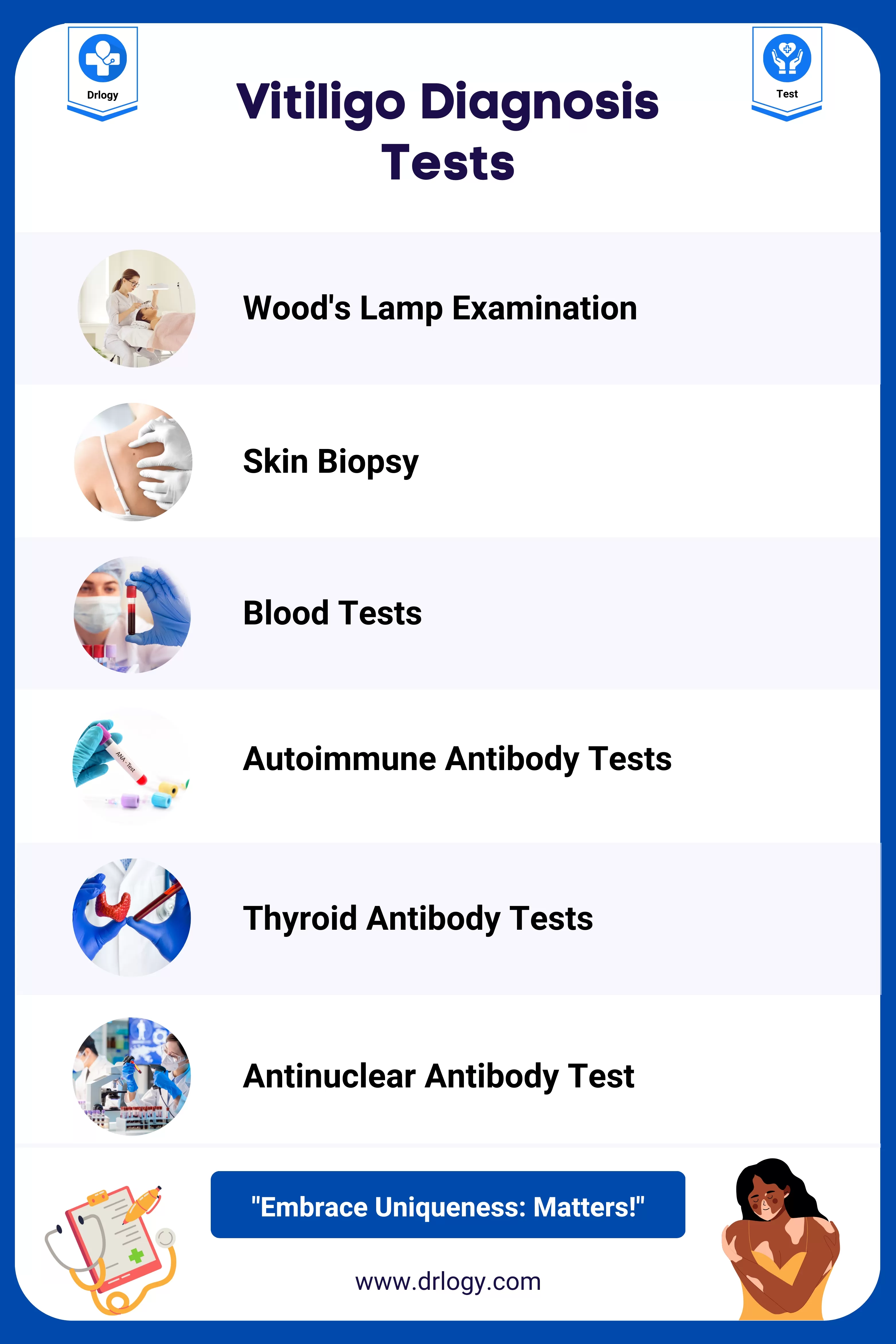
Here is a list of 6 common test of Vitiligo Diagnosis:
- Wood's Lamp Examination
- Skin Biopsy
- Blood Tests
- Autoimmune Antibody Tests
- Thyroid Antibody Tests
- Antinuclear Antibody Test
1. Wood's Lamp Examination
- Uses ultraviolet light to assess the extent of depigmentation in vitiligo diagnosis.
- Helps determine the borders and activity of the affected areas.
- Aids in planning treatment options and monitoring disease progression.
| Wood's Lamp Examination | Details |
|---|---|
| Also Known As | UV examination |
| Purpose | Assess & monitor disease |
| Sample | Skin |
| Preparation | Clean skin surface |
| Procedure | Expose skin to UV light, and observe color changes. |
| Test Timing | 5-10 minutes |
| Test Price (INR) | 500-1500 |
| Result Value | Qualitative |
| Normal Value | Absence of fluorescence in vitiligo patches. |
| Accuracy | High |
| Interpretation | Assesses vitiligo by observing skin color changes under UV light with high accuracy. |
Wood's Lamp Examination, also known as UV examination, assesses depigmentation, determines borders, and monitors vitiligo diagnosis. It involves exposing the skin to UV light, observing color changes.
2. Skin Biopsy
- Involves removing a small sample of skin for microscopic examination.
- Helps confirm the diagnosis of vitiligo and rule out other skin conditions.
- Assists in assessing the absence of melanocytes and determining disease severity.
| Skin Biopsy | Details |
|---|---|
| Also Known As | Cutaneous Biopsy |
| Purpose | Confirm diagnosis, and rule out other conditions. |
| Sample | Skin tissue |
| Preparation | Local anesthesia, cleaning area |
| Procedure | Small sample removal for microscopic examination. |
| Test Timing | A few days |
| Test Price (INR) | 2000-5000 |
| Result Value | Histopathological findings |
| Normal Value | Presence of melanocytes, absence of abnormalities. |
| Accuracy | High |
| Interpretation | Abnormal findings indicate potential disorders. |
Skin Biopsy confirms vitiligo diagnosis, rules out other conditions. It's a high-accuracy test using skin tissue samples. Normal results show melanocytes' presence, absence of abnormalities.
3. Blood Tests
- Assess overall health andentify underlying conditions associated with vitiligo diagnosis.
- Include complete blood count (CBC), thyroid function tests, and autoimmune antibody tests.
- Help detect abnormalities that may contribute to the development or progression of vitiligo diagnosis.
| Blood Tests | Details |
|---|---|
| Also Known As | Blood work |
| Purpose | Assess overall health, and detect underlying conditions. |
| Sample | Blood |
| Preparation | Fasting |
| Procedure | Collection of blood samples and laboratory analysis. |
| Test Timing | 2-5 hours |
| Test Price (INR) | 500-3000 |
| Result Value | Quantitative |
| Normal Value | Varies based on specific tests |
| Accuracy | Varies by test |
| Interpretation | Comparison to reference ranges,entification of abnormalities. |
Blood tests, also known as blood work, assess overall health, detect underlying conditions. They involve collecting a blood sample for laboratory analysis. Results are quantitative, accurate, and helpentify abnormalities.
4. Autoimmune Antibody Tests
- Assess overall health andentify underlying conditions associated with vitiligo diagnosis.
- Include complete blood count (CBC), thyroid function tests, and autoimmune antibody tests.
- Help detect abnormalities that may contribute to the development or progression of vitiligo.
| Autoimmune Antibody Tests | Details |
|---|---|
| Also Known As | Autoantibody tests |
| Purpose | Detect autoimmune antibodies associated with vitiligo. |
| Sample | Blood |
| Preparation | Fasting |
| Procedure | Blood sample collection, and laboratory testing. |
| Test Timing | 1-2 hours |
| Test Price (INR) | 1000-3000 |
| Result Value | Qualitative |
| Normal Value | Absence of specific autoimmune antibodies. |
| Accuracy | Moderate to high |
| Interpretation | Positive: Presence of autoimmune antibodies; Negative: Absence of autoimmune antibodies. |
Autoimmune Antibody Tests detect specific autoimmune antibodies associated with vitiligo diagnosis. High accuracy, blood sample required.
5. Thyroid Antibody Tests
- Detect antibodies associated with autoimmune thyroid disorders, often linked to vitiligo.
- Helpentify underlying thyroid dysfunction in individuals with vitiligo diagnosis.
- Assist in determining appropriate management strategies and monitoring thyroid health.
| Thyroid Antibody Tests | Details |
|---|---|
| Also Known As | Autoimmune Thyroid Tests |
| Purpose | Detect antibodies related to thyroid diseases. |
| Sample | Blood |
| Preparation | Fasting may be required |
| Procedure | Blood sample collection, laboratory analysis. |
| Test Timing | 1-2 hours |
| Test Price (INR) | 1000-3000 |
| Result Value | Quantitative |
| Normal Value | Based on specific antibodies |
| Accuracy | Moderate to high |
| Interpretation | Positive: Presence of thyroid antibodies; Negative: Absence. |
Thyroid Antibody Tests, also known as Autoimmune Thyroid Tests, detect antibodies related to thyroid diseases. It involves a blood sample, with high accuracy and varying normal values.
6. Antinuclear Antibody Test
- Detect the presence of specific antibodies associated with autoimmune thyroid diseases.
- Helpentify potential thyroid involvement in vitiligo patients.
- Assist in diagnosing autoimmune thyroid conditions that may coexist with vitiligo.
| Antinuclear Antibody Test | Details |
|---|---|
| Also Known As | ANA Test |
| Purpose | Detect autoimmune disorders |
| Sample | Blood |
| Preparation | Fasting not required |
| Procedure | Blood draw, lab analysis |
| Test Timing | 1-2 hours |
| Test Price (INR) | 1000-3000 |
| Result Value | Titers, pattern |
| Normal Value | Negative |
| Accuracy | Moderate to high |
| Interpretation | Positive: Autoimmune condition suspected. |
The Antinuclear Antibody (ANA) Test detects autoimmune disorders through a blood sample. It is performed without fasting, providing moderate to high accuracy. Normal value is negative, and a positive result indicates a potential autoimmune condition.
Vitiligo Diagnosis Tests Overview
| Test Name | Wood's Lamp Examination | Skin Biopsy | Blood Tests |
|---|---|---|---|
| Also Known As | UV examination | Cutaneous Biopsy | Blood work |
| Purpose | Assess & monitor disease | Confirm diagnosis, and rule out other conditions. | Assess overall health, and detect underlying conditions. |
| Sample | Skin | Skin tissue | Blood |
| Preparation | Clean skin surface | Local anesthesia, cleaning area | Fasting |
| Procedure | Expose skin to UV light, and observe color changes. | A small sample of skin was taken for analysis. | Laboratory analysis of blood samples. |
| Test Timing | 5-10 minutes | A few days | 2-5 hours |
| Test Price (INR) | 500-1500 | 2000-5000 | 500-3000 |
| Result Value | Qualitative | Histopathological findings | Quantitative |
| Normal Value | Absence of fluorescence in vitiligo patches. | Presence of melanocytes, absence of abnormalities. | Based on specific test |
| Accuracy | High | High | Varies by test |
| Interpretation | Assesses vitiligo by observing skin color changes under UV light. | Abnormal findings indicate potential disorders. | Comparison to reference ranges,entification of abnormalities. |
*Test Price, range, and timing may vary as per location, lab type, and procedure.
Wood's Lamp Examination assesses vitiligo by observing color changes. Skin Biopsy confirms diagnosis and rules out other conditions. Blood Tests detect underlying conditions, providing insights into overall health.
Vitiligo Differential Diagnosis
| Similar Diseases | Differentiating Factors |
|---|---|
| Pityriasis alba | Scales or dry patches |
| Tinea versicolor | Fungal infection |
| Post-inflammatory hyperpigmentation | History of skin inflammation |
| Piebaldism | Genetic inheritance |
| Leprosy | Sensory loss, thickened nerves |
| Halo nevus | A pigmented mole with depigmented border |
vitiligo diagnosis can be differentiated from similar diseases such as Pityriasis alba, Tinea versicolor, and Post-inflammatory hyperpigmentation based on specific factors like scales, fungal infection, and history of inflammation.
Best Doctor for Vitiligo
| Specialist | Description |
|---|---|
| Dermatologist | Skin disorder expert |
| Immunologist | Immune system specialist |
| Cosmetologist | Aesthetics and skin care |
| Endocrinologist | Hormonal imbalance focus |
| Psychologist | Mental health support |
The best doctor for vitiligo - a Dermatologist, an expert in skin disorders.
7 Interesting Facts of Vitiligo Diagnosis
- Vitiligo diagnosis often involves using a Wood's lamp to examine the skin under UV light.
- A biopsy can confirm vitiligo by observing the absence of melanocytes.
- Blood tests may be conducted to rule out underlying conditions.
- Certain autoimmune antibody tests can help detect associated diseases.
- Eye examinations are recommended to check for associated eye conditions.
- A psychological evaluation can assess the emotional impact of vitiligo diagnosis.
- Family history assessment helps determine genetic predisposition to vitiligo.
Conclusion
Vitiligo diagnosis involves various methods like Wood's lamp examination, skin biopsy, and blood tests. These tests help confirm the condition, rule out underlying diseases, and provide a comprehensive assessment. Early and accurate diagnosis is crucial for effective treatment and support.
Reference
FAQ
What are the common methods used for vitiligo diagnosis?
The common methods used for vitiligo diagnosis include:
- Wood's Lamp Examination (UV examination)
- Skin Biopsy (Cutaneous Biopsy)
- Blood Tests
- Autoimmune Antibody Tests
- Thyroid Antibody Tests
- Antinuclear Antibody Test (ANA Test)
How accurate are the diagnostic tests for vitiligo?
The accuracy of diagnostic tests for vitiligo varies. Wood's Lamp Examination and Skin Biopsy have high accuracy in confirming the condition. Blood tests, including autoimmune antibody tests and thyroid antibody tests, have moderate to high accuracy in detecting associated conditions. The Antinuclear Antibody Test also has moderate to high accuracy in identifying autoimmune disorders.
Why is early and accurate diagnosis important in vitiligo?
Early and accurate diagnosis in vitiligo is important to initiate timely treatment, manage disease progression, and provide psychological support. It allows for better outcomes, improved quality of life, and the opportunity to address associated conditions. Additionally, early intervention can prevent further depigmentation and enhance the effectiveness of therapeutic interventions.