Body Measurements
Blood & Cholesterol
Medical Measurements
Body Measurements
Health Scores
Temperature & Time
Miscellaneous Conversions
Small Mammal Pregnancy
Sheep & Mare Gestation
Swine & Livestock Gestation
Doctors Nearby Me
Top Healthcare Professionals
Lab Tests
Health & Medical Days
Calculator
Drlogy Hospital Software
Drlogy Specialty Software
Drlogy Pathology Lab Software
1000+ Pathology Lab Report Format
Drlogy Radiology Software
Drlogy Free Profile Listing
Drlogy Letterhead
Drlogy ICD Codes
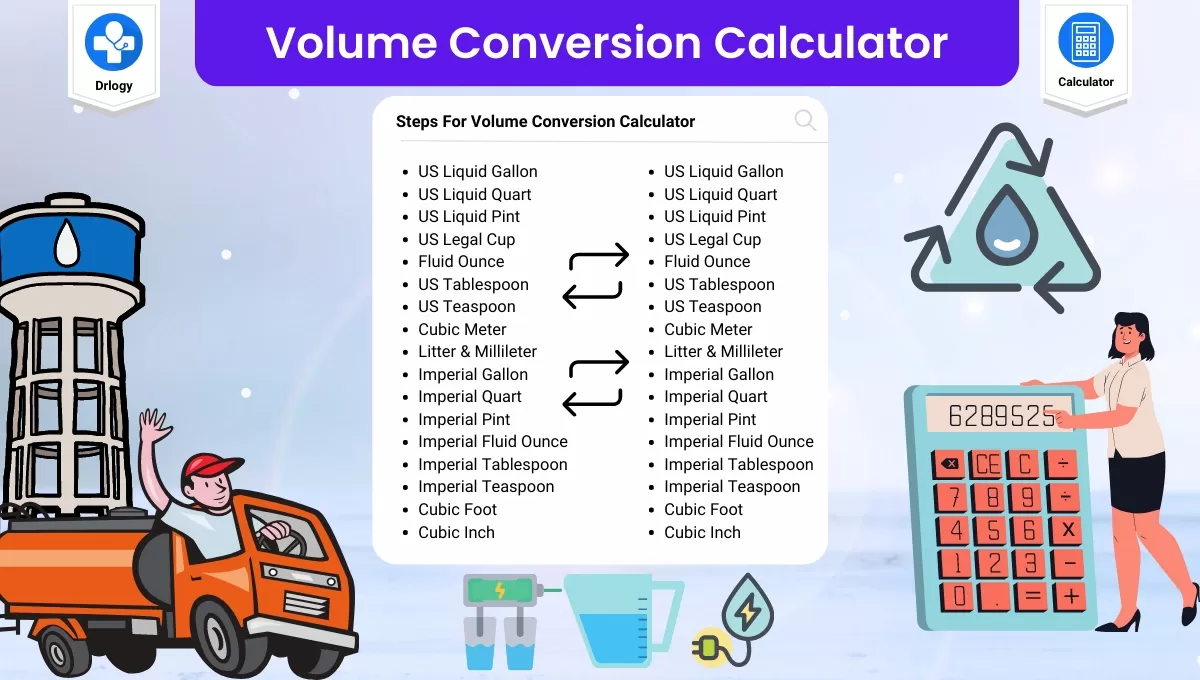
The conversion of units for volume can vary depending on the units being converted. Here are some common conversion factors for volume:
To convert a volume from one unit to another, you need to know the conversion factor between the two units. Here are the general steps to convert volume:
Determine the volume you want to convert and it's unit.
Find the conversion factor for the unit you want to convert from and the unit you want to convert to.
Multiply the volume you want to convert by the conversion factor to get the equivalent volume in the new unit.
For example, let's say you have a volume of 3 cubic meters (m³) and want to convert it to liters (L). The conversion factor between cubic meters and liters is 1000, so you would multiply 3 m³ by 1000 to get the equivalent volume in liters:
3 m³ x 1000 = 3000 L
So 3 cubic meters is equivalent to 3000 liters.
It's important to keep track of units during conversions and ensure your final answer is in the desired unit. Additionally, be aware that there may be rounding or precision errors when converting between units.
Calculating volume units depends on the shape of the object or container being measured. Here are some common formulas for calculating volume units for different shapes:
Cube or Rectangular Prism: Volume (in cubic units) = Length x Width x Height
Cylinder: Volume (in cubic units) = π x radius^2 x height
Sphere: Volume (in cubic units) = (4/3) x π x radius^3
Cone: Volume (in cubic units) = (1/3) x π x radius^2 x height
Once you have calculated the volume in cubic units, you can convert it to the desired volume unit (e.g. liters, milliliters) using the appropriate conversion factor. For example, to convert cubic meters to liters, you would multiply the volume in cubic meters by 1000, since 1 cubic meter is equal to 1000 liters.
It's important to keep track of units during calculations and conversions to avoid errors or confusion. Additionally, be aware that rounding or precision errors may occur during calculations.
DOCTOR'S MOST TRUSTED HEALTHCARE PLATFORM
10M+
Patients
30000+
Doctors
25000+
Hospitals/Labs
 Drlogy