• Drlogy Plus

How do you calculate 15 percent tip on a calculator?

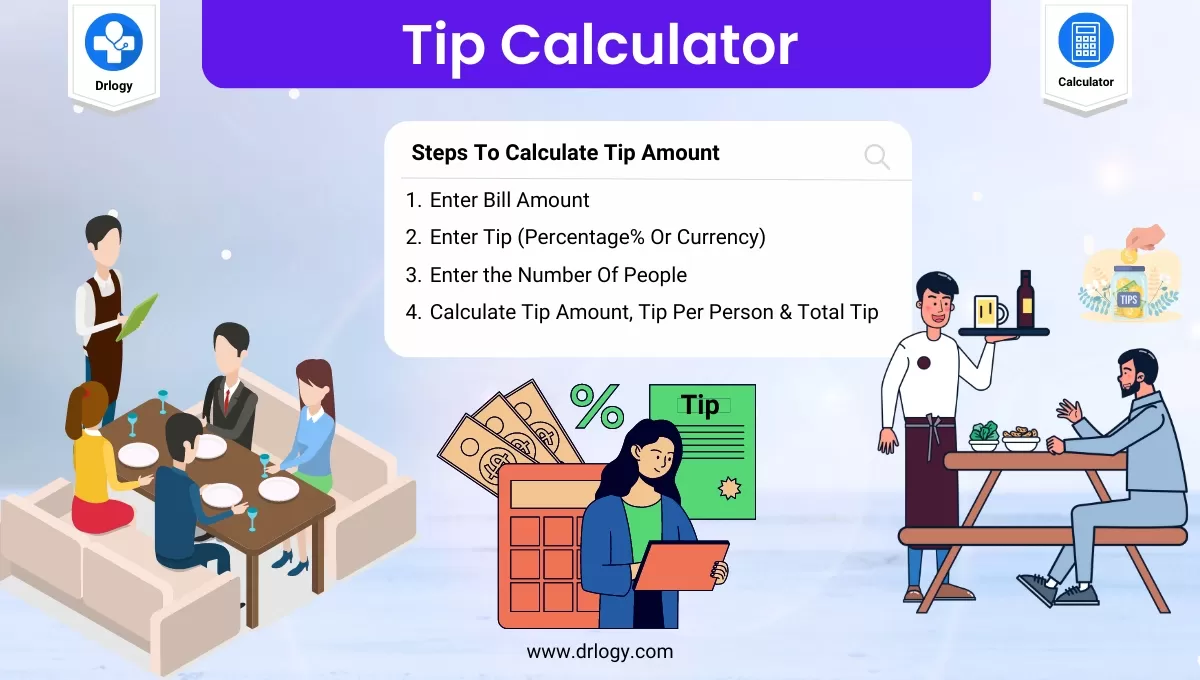
Calculating a 15% tip on a calculator is a straightforward process. Simply enter the bill amount on the calculator and then multiply it by 0.15 (which is 15% as a decimal). For example, if the bill is $40, multiplying it by 0.15 gives you $6 (15% tip). The result is the amount you should leave as a gratuity for the service. Using a calculator ensures accuracy and is especially helpful when dealing with larger bill amounts or when you need precise tipping calculations. It's a quick and reliable way to calculate tips and show appreciation for excellent service in various situations, such as dining out or receiving personal services.

FAQ

How do I calculate tip percentage in Excel?

To calculate tip percentage in Excel, you can use a simple formula. Assuming the total bill amount is in cell A1, and the tip amount is in cell B1, follow these steps: Step 1: In cell B1, type the formula "=A1*0.15" (without quotes) if you want to calculate a 15% tip. Replace "0.15" with the desired tip percentage as a decimal (e.g., 0.18 for 18% or 0.20 for 20%). Step 2: Press Enter. Excel will calculate the tip amount automatically based on the tip percentage and the total bill amount. If you want to display the result as currency, you can format cell B1 as currency. To do this, select cell B1, right-click, choose "Format Cells," go to the "Number" tab, and select "Currency." Now, the cell will display the tip amount in currency format. Excel is a powerful tool for calculations, and using formulas simplifies the process of finding tip percentages quickly and accurately.

How do you calculate tip fast?

Calculating tips quickly can be done using mental math techniques and estimation. One common method is to find 10% of the total bill, which can be achieved by moving the decimal point one place to the left. For instance, to calculate a 10% tip on a $70 bill, 10% is $7 (move the decimal point one place to the left). To find 15%, you can add half of the 10% value to the 10% tip. In this case, half of $7 is $3.50, and $7 + $3.50 = $10.50. So, a 15% tip on a $70 bill is $10.50. Similarly, for an 18% tip, you can find 10% and then add 8% (half of 16%) to it. By using these mental math tricks, you can calculate tips fast without the need for a calculator. It's a convenient way to show appreciation for good service and promote positive interactions in various situations.

How do you work out 18% of 50?

To calculate 18% of 50, you can follow a similar formula: Percentage × Amount = Result. Step 1: Convert the percentage to a decimal. 18% is equal to 0.18. Step 2: Multiply the decimal percentage by the amount. 0.18 × 50 = 9. Therefore, 18% of 50 is 9. Another quick method is to divide the amount by 100 and then multiply by 18. Step 1: Divide 50 by 100 = 0.5. Step 2: Multiply 0.5 by 18 = 9. Both approaches yield the same result, 9, which is 18% of 50. Being able to calculate percentages mentally or using simple formulas is helpful in various situations, such as finding gratuities, sales tax, or proportions in everyday calculations.

How do you find 15% of 70?

To find 15% of 70, you can use the formula: Percentage × Amount = Result. In this case, 15% is the percentage, 70 is the amount, and we want to find the result, which is the 15% of 70. Step 1: Convert the percentage to a decimal. 15% is equivalent to 0.15. Step 2: Multiply the decimal percentage by the amount. 0.15 × 70 = 10.5. Therefore, 15% of 70 is 10.5. Another quick method to find 15% is to divide the amount by 100 and then multiply by 15. Step 1: Divide 70 by 100 = 0.7. Step 2: Multiply 0.7 by 15 = 10.5. Either approach will give you the same result, 10.5, which is 15% of 70. Finding percentages is a valuable skill in various scenarios, such as calculating tips, discounts, or proportions in everyday situations.

How to solve 30% of 50?

To calculate 30% of 50, multiply 50 by 0.30 (30% as a decimal). In this case, 30% of 50 is 15 (30% of 50 = 0.30 * 50 = 15). Tipping 30% of the total bill amount would result in a 30% gratuity. While 30% tipping is on the higher end of the tipping spectrum, some customers may choose this percentage to show extra appreciation for exceptional service or in situations where they wish to be particularly generous. Tipping percentages can vary based on individual preferences, cultural norms, and the level of service received. Whether it's 30% or a different percentage, leaving a fair and thoughtful tip is a way for customers to support service industry workers and acknowledge their efforts in providing a positive customer experience.

How do you calculate 12 percent tip?

To calculate a 12% tip, divide the total bill amount by 100 and then multiply by 12. For example, on a $60 bill, dividing by 100 gives 0.6, and multiplying by 12 gives a $7.20 tip (12% of $60 = $7.20). A 12% tip is less common than standard tipping percentages like 15%, 18%, or 20%, but some customers may choose it as a moderate gratuity option. It's essential to be mindful of the service quality and considerate when calculating the tip amount. Customers can adjust the percentage based on their satisfaction with the service received and the desired level of appreciation they want to express to the service provider. Tipping is a personal decision that allows customers to show gratitude for good service and support service industry workers in various settings.

How do you calculate 10% tip?

Calculating a 10% tip is straightforward. To find a 10% tip, divide the total bill amount by 10. For example, on a $50 bill, 10% is $5 (10% of $50 = $5). A 10% tip is often used as a quick and easy method to calculate gratuities, especially in situations where customers want to leave a smaller tip or when mental math is convenient. Some customers use the 10% tip as a starting point and then adjust the tip amount higher or lower based on their satisfaction with the service or the desired level of generosity. Whether it's 10% or a different percentage, tipping is a way for customers to show appreciation for service providers and promote positive interactions in various industries.

How do you calculate tip length?

The term "tip length" can have different meanings depending on the context. In some cases, "tip length" might refer to the measurement of the point or end of an object that extends farthest from the base or central axis. For example, in geometry, the tip length of a triangle is the distance between the vertex and the opposite side. In physics or engineering, it might refer to the length of the tip of a blade, wing, or other objects. To calculate the tip length, you would typically measure the distance from the tip to the relevant reference point. In other contexts, "tip length" might refer to the duration or length of a tip, advice, or suggestion provided to someone. The specific meaning of "tip length" depends on the subject matter and context in which it is used.

Can I tip less than 15%?

While 15% is a common tipping percentage, tipping less than 15% is possible and might be appropriate in certain circumstances. Tipping is a voluntary practice, and customers have the discretion to adjust the tip amount based on factors such as the level of service received, personal budget, and tipping customs in the region. For example, if the service was subpar or the customer has financial constraints, leaving a tip less than 15% might be acceptable. However, it's important to be considerate and fair to service industry workers, who often rely on gratuities as part of their income. In situations where the service was excellent or the customer can afford to do so, leaving a tip that aligns with or exceeds 15% can be a meaningful way to show appreciation for quality service. Ultimately, the decision to tip less than 15% should be based on individual circumstances and the customer's judgment of the service provided.

How do you tip in cash?

Tipping in cash involves leaving a gratuity in the form of physical currency directly to the service provider. When paying for services like dining in a restaurant, getting a haircut, or using a taxi, customers can give the tip amount in cash to the server, hairstylist, or driver as a token of appreciation. Tipping in cash provides immediate recognition and allows service industry workers to receive their gratuities directly. Some customers prefer tipping in cash as it enables them to show gratitude discreetly and avoids leaving the tip as part of a credit card transaction. However, the choice between cash or card tipping is entirely up to the customer's preference. Regardless of the method, tipping in cash is a thoughtful way to acknowledge the efforts of service providers and support them financially in their line of work.

How do you tip without a calculator?

Tipping without a calculator can be done using mental math tricks or estimation techniques. For instance, to calculate a 15% tip, you can find 10% of the bill amount by moving the decimal point one place to the left and then add half of that value to get 15%. For example, on a $50 bill, 10% is $5, and half of $5 is $2.50. Adding $5 and $2.50 gives a $7.50 tip, which is 15% of $50. Another approach is to find 5% of the bill amount (by halving the 10% value) and then multiply by three to get 15%. In this example, 5% of $50 is $2.50, and multiplying by three gives a $7.50 tip. Utilizing these mental math strategies allows you to calculate tips quickly and accurately without the need for a calculator. Being proficient in mental math simplifies the tipping process and makes it easier to show appreciation for good service in various settings.

What is a tip structure?

The term "tip structure" can have different interpretations depending on the context. In the context of finance or investment, a tip structure may refer to a system or plan for allocating tips or gratuities among service industry workers. For instance, in a restaurant, there might be a tip structure where tips are distributed among waitstaff, kitchen staff, and other employees based on specific rules or percentages. In this sense, a tip structure ensures fair and equitable distribution of gratuities among the staff. In other contexts, a tip structure might refer to the physical arrangement or shape of the tip of an object. For example, the tip structure of a leaf could describe its shape and characteristics, such as pointed, rounded, or serrated edges. The interpretation of "tip structure" depends on the subject matter and context, whether related to finance, objects, or other fields of study.

What is tip in school?

In a school context, the term "tip" might have multiple meanings depending on the context. It could refer to a piece of advice or suggestion given to students to improve their performance or approach to learning. For example, "Here's a helpful tip for acing your exams: start studying early and review regularly." Additionally, "tip" can also refer to the point or end of an object, such as the tip of a pencil or pen used for writing. In educational settings, teachers may provide tips and guidance to students to help them excel academically and develop essential skills. The term "tip" is commonly used in school environments to share valuable insights, strategies, or recommendations that contribute to students' success and growth. Encouraging the exchange of tips and knowledge in schools fosters a positive learning environment and supports students' academic development.

What is tip in physics?

In physics, "tip" usually refers to the point or end of an object that is farthest from the base or axis of rotation. For example, in a rotating object such as a spinning top or helicopter rotor, the tip is the outermost part of the object that moves the fastest and experiences the greatest velocity. Understanding the tip's behavior is essential in various physical phenomena, such as aerodynamics, fluid dynamics, and mechanics. The tip's characteristics can significantly impact an object's stability, efficiency, and performance. In aerodynamics, the tip vortices created by aircraft wings play a crucial role in lift and drag generation. Understanding the tip's role in physics enables engineers and scientists to design efficient and stable systems, leading to advancements in technology and applications in various fields, including aviation, engineering, and more.

Who started the tip?

The practice of tipping or leaving gratuities for services provided is deeply rooted in history and has evolved over time through different cultures and societies. It is challenging to attribute the invention of tipping to a specific individual or singular event. The concept of tipping likely emerged organically as a way for customers to show appreciation and reward service providers for their efforts. Historical records suggest that tipping has been practiced in various civilizations, including ancient Egypt, Greece, and Rome. The act of giving gratuities to servers, porters, and other service providers has been documented in different cultures throughout history. Today, tipping is a customary practice in many parts of the world and plays an essential role in supporting service industry workers and promoting positive customer-service interactions. While the origins of tipping are not traceable to a single individual, its historical and cultural significance has led to its widespread adoption in various societies.

Is it tip or tips?

The usage of "tip" or "tips" depends on the context in which it is used. In the singular form, "tip" refers to the act of leaving a gratuity or the specific amount of money given as a tip. For example, "I will leave a tip for the excellent service." In the plural form, "tips" typically refers to multiple pieces of advice or suggestions given to help someone improve or succeed in a particular area. For instance, "Here are some tips for better time management." It's essential to use the correct form based on the intended meaning to ensure clear communication. The context of the sentence guides whether "tip" or "tips" is the appropriate word to use.

Who invented the tip?

The concept of tipping or leaving gratuities for services rendered has a long history and cannot be attributed to a single individual or culture. Tipping practices have evolved over centuries and have been a part of various societies in different forms. Historically, gratuities were given as a token of appreciation to servers, porters, and other service providers. The exact origins of tipping are not entirely clear, but it has been documented in different cultures and time periods. In ancient civilizations, tipping was practiced as a way to reward good service and build positive relationships with service providers. Over time, tipping customs have evolved, and today, it is a common practice in many parts of the world. While the concept of tipping is widespread, it is challenging to attribute its invention to a specific individual or culture due to its historical and cultural significance.

Why do we use tips?

Tips are used as a form of gratuity to show appreciation for the services provided by service industry workers. When customers receive satisfactory or excellent service, they may choose to leave a tip as a way to reward and acknowledge the efforts of the service providers. Tipping is a voluntary practice and allows customers to express gratitude for the positive experiences they receive. Additionally, tips help support service industry workers financially, as their wages may often be lower, and they rely on gratuities as part of their income. By leaving tips, customers contribute to the livelihood of service providers and encourage them to continue delivering exceptional service. Tipping is a social custom in many cultures and plays a crucial role in promoting positive customer-service interactions and supporting service professionals in various industries such as restaurants, hotels, salons, and transportation.

What are called tips?

Tips, in the context of tipping, are the voluntary gratuities given by customers to service industry workers for the services provided. When customers are pleased with the service they receive, they may choose to leave a tip as a gesture of appreciation and acknowledgment. Tips can come in various forms, including cash left on the table in restaurants, added to a credit card payment, or given directly to the service provider. The term "tips" can also refer to pieces of advice or suggestions given to help someone improve or succeed in a specific area. For instance, "fitness tips" offer guidance for staying healthy, and "study tips" provide advice for effective studying. The meaning of "tips" depends on the context in which it is used, whether related to tipping or as helpful pieces of advice.

What is tips full for?

The term "tips" can have multiple meanings depending on the context. In the context of tipping, "tips" refer to the money given voluntarily by customers to service industry workers as a gratuity for services rendered. Tipping is a way for customers to show appreciation and reward good service. In other contexts, "tips" can also refer to pieces of advice or suggestions given to help someone improve or succeed in a specific area. For example, "cooking tips" provide guidance for better cooking, and "travel tips" offer advice for smoother travels. Understanding the context in which the term "tips" is used helps avoid confusion and ensures accurate communication.

How do you calculate tip velocity?

Tip velocity is not a term commonly used in tipping or gratuities. However, in other contexts like physics or engineering, "velocity" refers to the rate of change of an object's position with respect to time. It is calculated by dividing the change in position (displacement) by the time taken. There is no direct concept of "tip velocity" in tipping practices. Instead, to calculate a tip, you would typically use the tip percentage (e.g., 15%, 18%, etc.) and multiply it by the total bill amount. For example, to calculate a 15% tip on a $50 bill, you would multiply $50 by 0.15 to get a $7.50 tip. Being accurate and clear in the terminology used when referring to tipping or other concepts ensures effective communication and understanding.

Is 20% tip cheap?

No, a 20% tip is not considered cheap. In fact, a 20% tip is often viewed as a generous and respectable gratuity for good service. Leaving a 20% tip means the customer is giving a gratuity that is 20% of the total bill amount, which is considered a higher tipping percentage. Customers might choose to tip 20% to show extra appreciation for exceptional service or in settings where service industry workers rely heavily on tips as part of their income. While 20% is a common tipping rate in some regions, tipping practices can vary, and customers are free to adjust the tip amount based on their satisfaction and the level of service received. Being generous with tipping fosters positive interactions, supports service professionals, and acknowledges their hard work in delivering a positive customer experience.

Is it 15% or 18% tip?

The decision on whether to leave a 15% or 18% tip depends on the level of service received and the customer's generosity. Both 15% and 18% are common tipping percentages and are considered appropriate and respectful gratuities for satisfactory service. A 15% tip is often seen as a standard tipping rate, while an 18% tip is considered slightly more generous. Customers might choose to tip 18% to show extra appreciation for excellent service, especially in restaurants, hotels, or personal services. Ultimately, the choice between 15% or 18% depends on the customer's satisfaction and individual preferences. Whether it's 15% or 18%, leaving a fair and thoughtful tip helps support service providers and encourages them to continue delivering quality experiences to customers.

What is tip rate?

The tip rate refers to the percentage or amount of money given as a gratuity for services received. It represents the proportion of the total bill that a customer chooses to leave as a tip to show appreciation for the service provided. For example, if the tip rate is 15%, it means the customer is leaving a gratuity that is 15% of the total bill amount. The tip rate can vary based on cultural norms, individual preferences, and the level of service received. Common tip rates include 15%, 18%, and 20%, but customers can adjust the tip rate higher or lower based on their experience and satisfaction. Understanding the tip rate allows customers to make informed decisions when tipping and support service industry workers who often rely on gratuities as part of their income.

Is it good to tip 15%?

Tipping 15% is generally considered a good and reasonable gratuity for good service in many settings. It is a standard tipping percentage that serves as a common guideline for showing appreciation to service providers. To calculate a 15% tip, simply multiply the total bill amount by 0.15 (15% as a decimal). For example, on a $60 bill, a 15% tip would be $9 (15% of $60). Leaving a 15% tip is a way for customers to acknowledge and reward quality service, especially in restaurants, hotels, and personal services. While 15% is a standard tipping rate, customers can adjust the tip amount based on their experience and level of satisfaction. Being generous and considerate with tipping fosters positive interactions and encourages service providers to continue delivering excellent experiences.
  • Home / 
  • Calculator  / 
  • FAQ  / 
  • How do you calculate 15 percent tip on a calculator?

DOCTOR'S MOST TRUSTED HEALTHCARE PLATFORM

10M+

Patients

30000+

Doctors

25000+

Hospitals/Labs

Day

Calculator

Test

Health

Plus