Body Measurements
Blood & Cholesterol
Medical Measurements
Body Measurements
Health Scores
Temperature & Time
Miscellaneous Conversions
Small Mammal Pregnancy
Sheep & Mare Gestation
Swine & Livestock Gestation
Doctors Nearby Me
Top Healthcare Professionals
Lab Tests
Health & Medical Days
Calculator
Drlogy Hospital Software
Drlogy Specialty Software
Drlogy Pathology Lab Software
1000+ Pathology Lab Report Format
Drlogy Radiology Software
Drlogy Free Profile Listing
Drlogy Letterhead
Drlogy ICD Codes
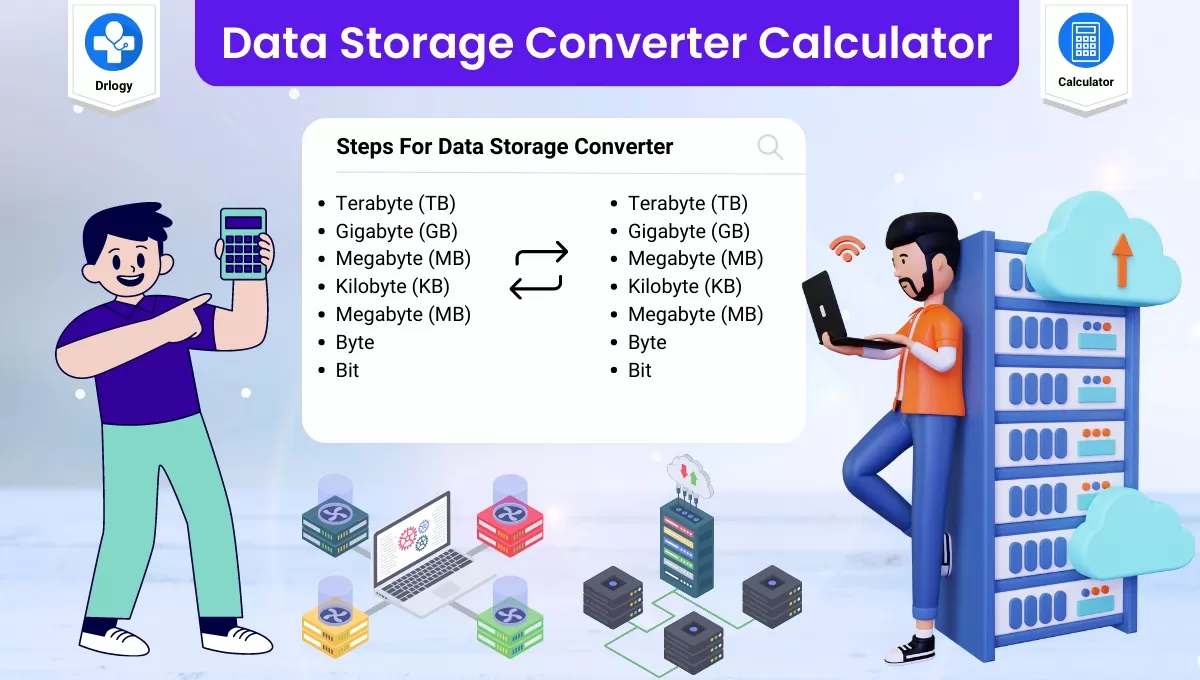
To convert data storage from one unit to another, you can use the appropriate conversion factor. The conversion factor depends on the units you are converting between. Here are the steps to convert data storage:
Determine the size of the data storage you want to convert.
Determine the conversion factor between the units you are converting. For example, to convert from kilobytes (KB) to megabytes (MB), the conversion factor is 1 MB = 1024 KB.
Multiply the size of the data storage by the conversion factor to get the equivalent value in the desired unit. For example, to convert 500 KB to MB, you would multiply 500 by 1/1024 (since 1 MB = 1024 KB), which equals approximately 0.488 MB.
Round the result to the desired number of decimal places.
Here is an example conversion from gigabytes (GB) to terabytes (TB):
Suppose you have a hard drive with a storage capacity of 4.5 GB.
The conversion factor between GB and TB is 1 TB = 1024 GB.
To convert 4.5 GB to TB, divide by 1024:
4.5 GB / 1024 = 0.00439453 TB
0.00439453 TB ≈ 0.00 TB (rounded to two decimal places)
Therefore, the storage capacity of the hard drive is approximately 0.00 TB.
DOCTOR'S MOST TRUSTED HEALTHCARE PLATFORM
10M+
Patients
30000+
Doctors
25000+
Hospitals/Labs
 Drlogy