
Smooth Muscle Antibodies (SMA) Test To Diagnose Autoimmune Hepatitis
The Smooth Muscle Antibodies (SMA) test is a blood test used to check for specific antibodies in your body that can help diagnose autoimmune hepatitis, a liver condition. It's a diagnostic tool to assess liver health.
SMA Test
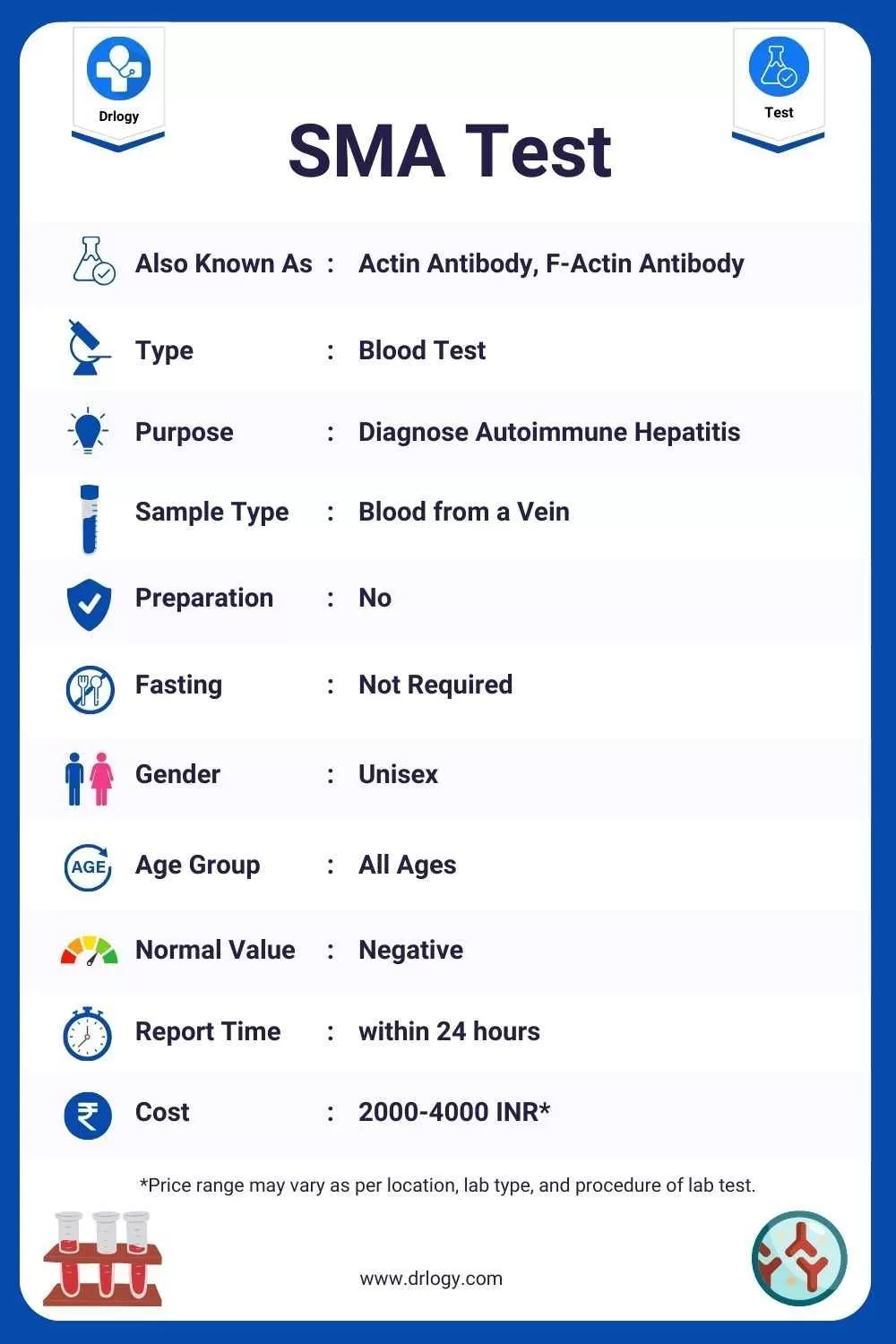
Here are the basic details of the SMA Test.
| Also Known As | ASMA, Actin Antibody, F-Actin Antibody |
| Type | Blood Test |
| Purpose | Diagnose Autoimmune Hepatitis, Liver Health Assessment |
| Sample Type | Blood from a Vein |
| Preparation | No |
| Fasting | Not Required |
| Gender | Unisex |
| Age Group | All Ages |
| Normal Value | Negative |
| Reporting Time | within 24 hours |
| Cost | 2000-4000 INR* |
*Price range may vary as per location, lab type, and procedure of lab test.
SMA Test Means
- SMA Test, or Smooth Muscle Antibody Test, is a diagnostic blood test used to detect autoimmune hepatitis by measuring autoantibodies targeting smooth muscle actin.
- This test assists in distinguishing autoimmune hepatitis from other liver conditions.
- It's especially valuable in cases of unexplained liver inflammation and damage.
- SMA Test can be performed without fasting, making it convenient for patients.
- Smooth Muscle Antibodies are relevant for individuals of all genders and ages.
SMA Test Purpose
The purpose of the SMA Test is to:
- SMA Test is primarily conducted to diagnose autoimmune hepatitis, an autoimmune liver disease, by detecting specific autoantibodies targeting smooth muscle actin.
- It helps differentiate autoimmune hepatitis from other liver disorders.
- The SMA Test is crucial when patients present with unexplained liver inflammation, jaundice, and fatigue.
- This diagnostic tool aids in early detection and timely treatment of autoimmune hepatitis.
- It is essential for assessing liver health and preventing potential liver damage.
SMA Test Preparation
Here is the basic preparation for the SMA Test.
Before Test
- No specific preparation is required.
- Inform the healthcare provider about any medications you are taking.
- Wear clothing with sleeves that can be easily rolled up.
During Test
- A healthcare professional will draw a blood sample from a vein in your arm.
- You may feel a brief needle prick or discomfort during the blood draw.
After Test
- You can resume normal activities immediately.
- Some people may experience slight bruising or swelling at the needle site.
- Await your test results, which are typically available within a day.
SMA Test Procedure
Here is the basic SMA Test Procedure.
- A blood sample drawn from an arm vein
- The sample sent to a lab for analysis
- Autoantibodies targeting smooth muscle actin detected
- Results reported to healthcare provider
- Helps diagnose autoimmune hepatitis and assess liver health
SMA Test Result
- Positive result: Indicates the presence of autoantibodies associated with autoimmune hepatitis.
- Negative result: Suggest the absence of these specific antibodies.
- Interpretation by a healthcare provider is crucial for diagnosis and further action.
SMA Test Normal Result
Here is the normal result of the SMA Test.
| Test | Normal Result |
|---|---|
| SMA Test | Normally, there are no antibodies present. |
SMA Test Interpretation
Here is the Interpretation of the SMA Test.
| Test Result | Interpretation |
|---|---|
| Positive | Autoimmune hepatitis is likely. |
| Negative | Absence of specific antibodies. |
SMA Test Positive
Here are the potential causes of positive SMA Test results:
| Possible Causes | Description |
|---|---|
| Autoimmune Hepatitis | Strong association with the disease. |
| Primary Biliary Cholangitis (PBC) | SMA may be present at lower levels. |
| Infectious Mononucleosis | Temporary elevation in some cases. |
| Hepatitis C Infection | This may result in elevated SMA. |
| Some Cancers | SMA may be detected, requiring further evaluation. |
Positive SMA test results may indicate autoimmune hepatitis, primary biliary cholangitis, infectious mononucleosis, or other conditions.
SMA Test Negative
Here are the potential causes of negative SMA Test results:
| Possible Causes | Description |
|---|---|
| Absence of Autoimmune Hepatitis | Suggests autoimmune hepatitis is not the cause. |
| Other Liver Conditions | Liver issues are due to different factors or infections. |
| No Specific Autoantibodies | SMA antibodies against smooth muscle actin were not found. |
| Potential Non-Hepatic Causes | Symptoms may be attributed to non-liver factors. |
A negative SMA test indicates the absence of specific antibodies related to autoimmune hepatitis, helping rule out the condition and other potential liver causes.
Specimen Requirements For SMA Test
Here are the specimen requirements for the SMA Test.
| Specimen | Serum | |
| Volume | 1 mL | |
| Container | Red-top tube or gel-barrier tube | |
| Collection | Separate serum from cells within an hour, transfer to plastic tubes, and submit separate frozen specimens for multiple tests. | |
| Storage | Refrigerate or freeze. | |
| Sample Stability | Temperature | Period |
| Room temperature | 7 days | |
| Refrigerated | 14 days | |
| Frozen | 60 days | |
| Freeze/thaw cycles | Stable x1 | |
| Causes for Rejection | Grossly hemolyzed; bacterial contamination; lipemic specimen; icteric specimen; non-serum specimen types | |
SMA Test is Safe?
- SMA test is generally safe and minimally invasive.
- It involves a standard blood draw from a vein.
- Risks are minimal and typically limited to slight discomfort at the needle site.
When Do You Get SMA Test Results?
- SMA test results are typically available within a day.
- The exact reporting time may vary depending on the laboratory.
- Your healthcare provider will communicate the results to you once available.
SMA Test Limitation
Here is the basic limitation of the SMA Test.
- SMA test results are not diagnostic on their own.
- Additional testing and clinical evaluation are necessary.
- Some individuals with autoimmune hepatitis may not have detectable SMA.
- SMA levels may vary over time, making interpretation challenging.
- False positives or negatives can occur; confirmatory tests may be needed.
SMA Test Risk Factors
Here are some of the risk factors of the SMA Test.
- No inherent health risks are associated with the SMA test.
- Risks primarily involve the standard blood draw procedure.
- Potential risks include minor discomfort, bruising, or infection.
- Rarely, individuals may experience fainting or dizziness during the blood draw.
- Risk factors may vary based on individual health conditions.
Doctor Recommendations After SMA Test Result
Here are the Doctor's recommendations or consult a specialist after the SMA Test.
| SMA Test Result | Doctor to Visit | Reason |
|---|---|---|
| Positive | Hepatologist | Confirm diagnosis and discuss treatment. |
| Negative | General Physician | Further evaluation of liver health. |
SMA Test Price
Here are the estimated SMA Test Prices in India with different top cities:
| City | Price Range (INR)* |
| 2000-4000 | |
| 3000-4200 | |
| 2000-4000 | |
| 3000-4200 | |
| 2000-4000 | |
| 3000-4200 | |
| 2000-4000 | |
| 3000-4200 | |
| 3000-4200 | |
| 2000-4000 | |
| 3000-4200 | |
| 2000-4000 | |
| 3000-4200 | |
| 2000-4000 |
*Prices are approximate and vary depending on a specific laboratory or healthcare facility.
Summary
Overall, The SMA test, detecting autoantibodies in a blood sample, aids in diagnosing autoimmune hepatitis, vital for early treatment and liver health assessment. Also check Drlogy Test for detailed information about all medical tests for patients, doctors, scholers and medical students.
Reference


