RBC Antibody Screen (Red Blood Cell Antibody) To Detect RBC Antibodies
RBC Antibody Screen is a blood test that helps doctors make sure the right blood is given during transfusions and checks for potential issues during pregnancy to keep both mom and baby healthy.
RBC Antibody Screen
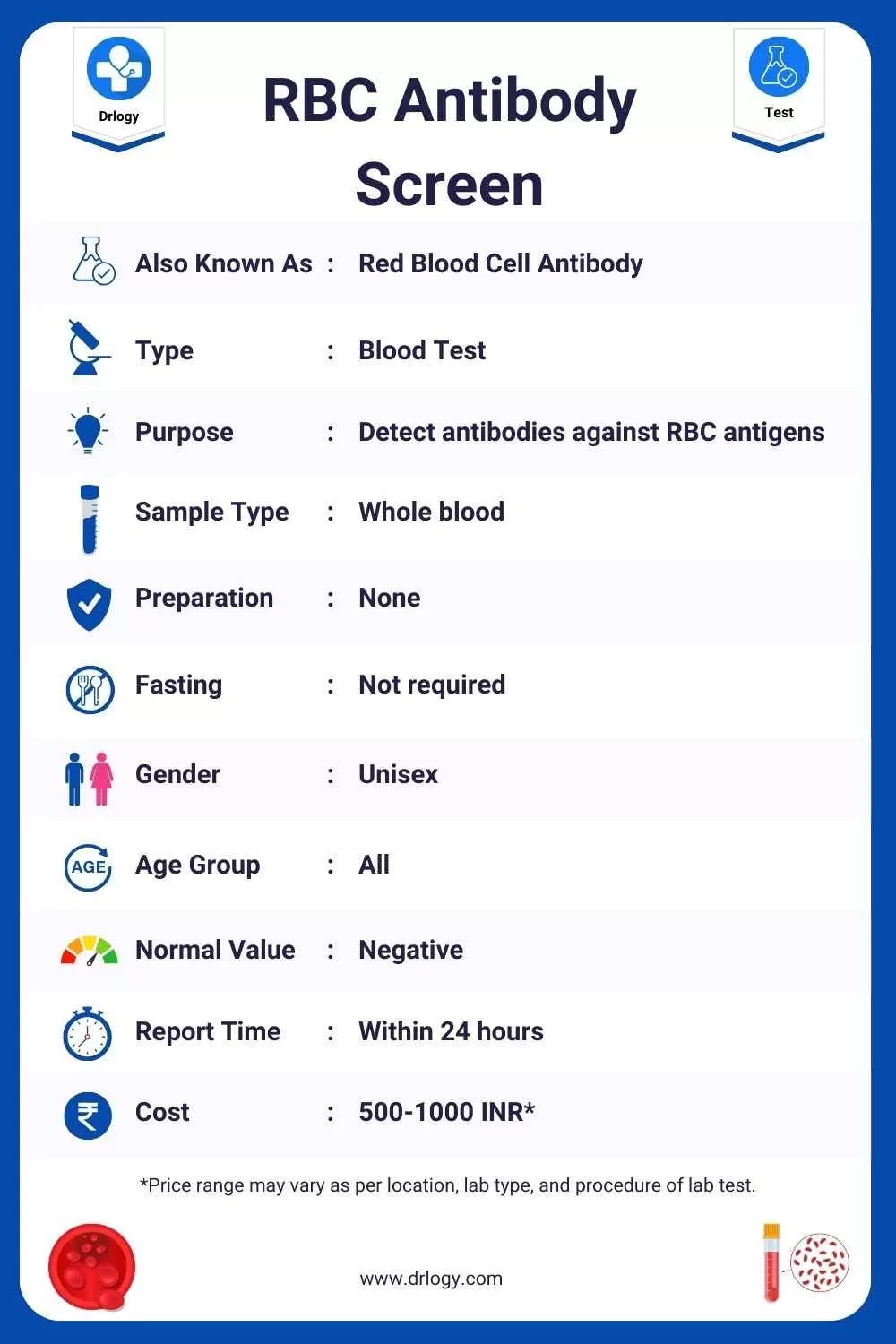
Here are the basic details of the RBC Antibody Screen.
| Also Known As | Red Blood Cell Antibody |
| Type | Blood Test |
| Purpose | Detect antibodies against red blood cell antigens |
| Sample Type | Whole blood |
| Preparation | None |
| Fasting | Not required |
| Gender | Unisex |
| Age Group | All |
| Normal Value | Negative |
| Reporting Time | Within 24 hours |
| Cost | 500-1000 INR* |
*RBC Antibody Screen Price range may vary as per location, lab type, and lab test procedure.
RBC Antibody Screen Means
RBC Antibody Screen is a blood test thatentifies antibodies against red blood cell antigens, aiding in transfusions and pregnancy monitoring.
- It ensures safe blood transfusions by matching compatible blood types.
- During pregnancy, it screens for antibodies that could harm the baby.
- It's vital to prevent hemolytic disease of the newborn (HDN).
- This test helps safeguard the health of both mother and baby.
RBC Antibody Screen Purpose
The purpose of the RBC Antibody Screen is to:
- The main purpose of an RBC Antibody Screen is to detect antibodiesected against red blood cell antigens.
- It ensures safe blood transfusions by matching compatible blood types.
- During pregnancy, it screens for antibodies that could harm the baby.
- It's essential to prevent hemolytic disease of the newborn (HDN).
- This test safeguards the health of both mother and baby.
RBC Antibody Screen Preparation
Here is the basic preparation for the RBC Antibody Screen.
Before Test
- No specific preparation is required.
- No need for fasting.
- Inform your healthcare provider of any medical conditions.
During Test
- A blood sample is drawn from a vein in your arm.
- The procedure is typically quick and straightforward.
- You may feel a slight pinch or discomfort during the blood draw.
After Test
- No special post-test instructions are typically needed.
- You can resume your usual activities.
RBC Antibody Screen Procedure
Here is the basic RBC Antibody Screen Procedure.
- A blood sample drawn from a vein in the arm.
- Sample processing in the laboratory.
- Antibodyentification test may follow if a positive result.
- Results reported to the healthcare provider.
RBC Antibody Screen Result
Here is the basic reading of the RBC Antibody Screen results.
- Positive: Antibodies against red cell antigens found.
- Negative: No RBC antibodies detected.
- Further tests for specificity if positive.
RBC Antibody Screen Normal Result
Here is the normal result of the RBC Antibody Screen.
| Test | Normal Result |
|---|---|
| RBC Antibody Screen | Negative |
RBC Antibody Screen Interpretation
Here is the Interpretation of the RBC Antibody Screen.
| Test Result | Interpretation |
|---|---|
| Positive | Antibodies detected |
| Negative | No antibodies detected |
RBC Antibody Screen helpsentify red blood cell antibodies for safe transfusions, with positive results indicating the presence of antibodies.
RBC Antibody Screen Positive
Here are the potential causes of positive RBC Antibody Screen:
| Possible Causes | Description |
|---|---|
| Blood transfusion | Development of antibodies from past transfusions |
| Pregnancy | Exposure to fetal blood antigens during pregnancy |
| Autoimmune condition | The body produces antibodies against its own RBCs |
| Medications or infections | May trigger antibody production |
Positive RBC Antibody Screen may result from transfusions, pregnancy, autoimmune conditions, or medications.
RBC Antibody Screen Negative
Here are the potential causes of negative RBC Antibody Screen:
| Possible Causes | Description |
|---|---|
| No previous exposure | No history of blood transfusions or pregnancies |
| Recent or mild exposure | Antibodies may not have developed yet or are at low levels |
| Compatibility with donor blood | Blood type matches with transfused blood |
| Lack of autoimmune conditions | No production of antibodies against one's own RBCs |
| No medication-induced antibodies | Medications haven't triggered antibody production |
A negative RBC Antibody Screen often indicates no prior exposure, mild exposure, or compatibility with donor blood.
Specimen Requirements For RBC Antibody Screen
Here are the specimen requirements for the RBC Antibody Screen.
| Specimen | Whole blood | |
| Volume | 4 mL | |
| Container | Lavender-top (EDTA) tube | |
| Collection | Specimens should be tested as soon as possible or within 72 hours of collection. | |
| Storage Instructions | Samples that cannot be tested immediately should be stored at 2°C to 8°C. Do not freeze red cells. | |
| Causes for Rejection | Gross hemolysis; bacterial or other contamination | |
RBC Antibody Screen is Safe?
- RBC Antibody Screen is a safe blood test with minimal risks and side effects.
- It is commonly performed without adverse effects, ensuring safe transfusions and pregnancies.
- The benefits of this test in preventing complications outweigh any potential discomfort.
- Overall, RBC Antibody Screen is generally well-tolerated and safe for patients.
When Do You Get RBC Antibody Screen Results?
- Results typically become available within a short timeframe, usually within a day.
- The specific reporting time can vary depending on the laboratory and healthcare provider.
- Rapid access to results allows for prompt diagnosis and treatment decisions.
RBC Antibody Screen Limitation
Here is the basic limitation of the RBC Antibody Screen.
- May notentify all rare antibodies.
- Specificity may vary among different screening tests.
- Results can be influenced by sample quality.
- Positive screens require further antibodyentification.
- Limited ability to diagnose other underlying conditions.
RBC Antibody Screen Risk Factors
Here are some of the risk factors of the RBC Antibody Screen.
- Multiple blood transfusions increase antibody production.
- Pregnancy with blood type incompatibility.
- Autoimmune disorders may trigger antibody formation.
- Medications or infections can lead to antibodies.
- Genetic predisposition to RBC antibody production.
Doctor Recommendations After RBC Antibody Screen Result
Here are the Doctor's recommendations or consult a specialist after the RBC Antibody Screen.
| Test Result | Doctor to Visit | Reason to Visit |
|---|---|---|
| Positive | Hematologist | Evaluate and manage |
| Negative | No Immediate Visit | Routine monitoring |
RBC Antibody Screen Price
Here are the estimated RBC Antibody Screen Prices in India with different top cities:
| City | Price Range (INR)* |
| 500-1000 | |
| 2500-5000 | |
| 500-1000 | |
| 2500-5000 | |
| 500-1000 | |
| 2500-5000 | |
| 500-1000 | |
| 2500-5000 | |
| 2500-5000 | |
| 500-1000 | |
| 2500-5000 | |
| 500-1000 | |
| 2500-5000 | |
| 500-1000 |
*RBC Antibody Screen Price are approximate and vary depending on a specific laboratory or healthcare facility.
Summary
Overall, The RBC Antibody Screenentifies antibodies against red blood cell antigens, vital for safe transfusions and during pregnancies with blood type incompatibility. Also check Drlogy Test for detailed information about all medical tests for patients, doctors, scholers and medical students.
Reference


