
Lactoferrin Test To Detect Intestinal Inflammation and Monitor IBD
The lactoferrin test checks your poop for signs of gut inflammation. It helps diagnose bowel issues like IBD and differentiates them from non-inflammatory problems.
Lactoferrin Test
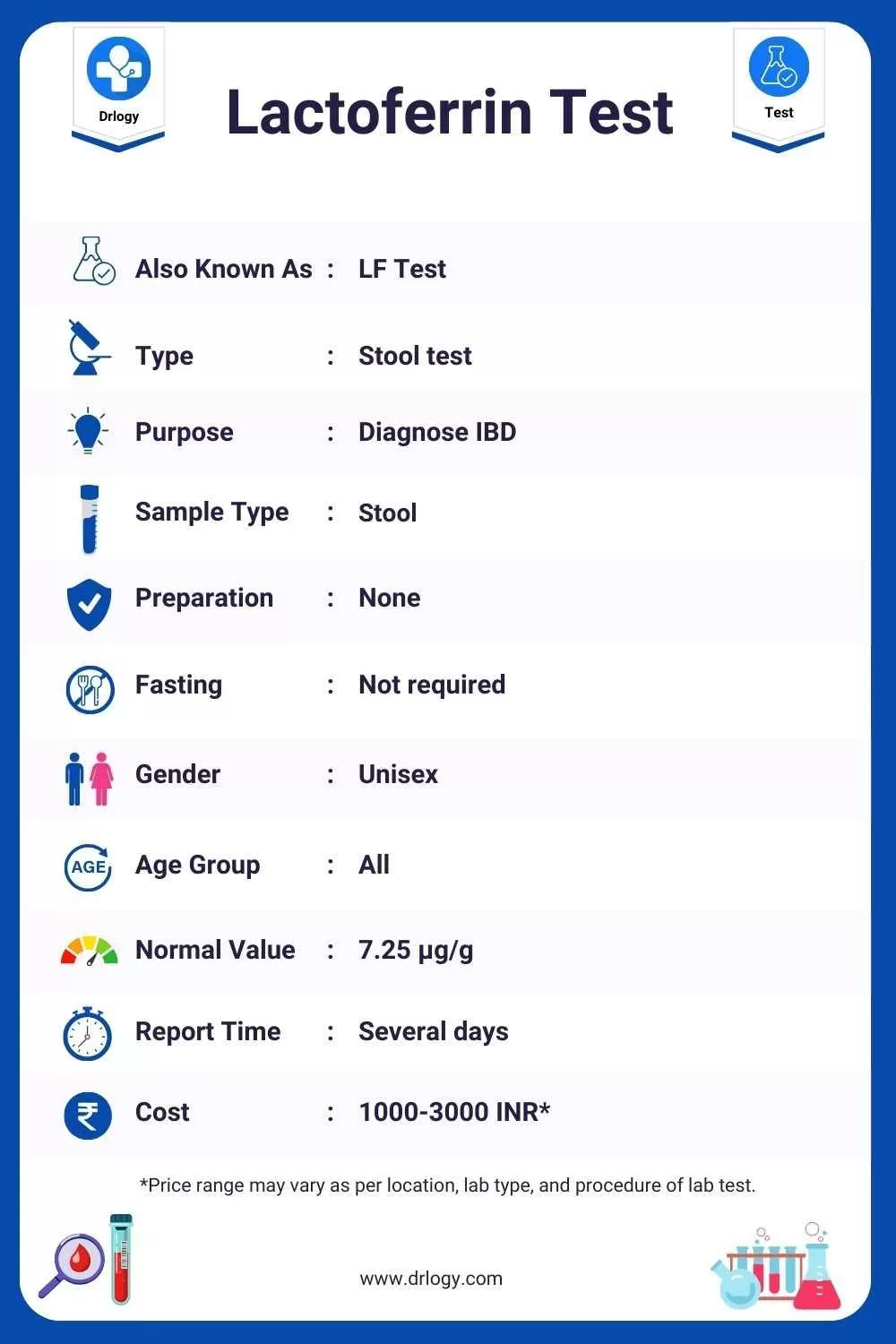
Here are the basic details of the Lactoferrin Test.
| Also Known As | LF Test, Lactoferrin (LF) |
| Type | Stool test |
| Purpose | Detect intestinal inflammation, diagnose IBD |
| Sample Type | Stool |
| Preparation | None |
| Fasting | Not required |
| Gender | Unisex |
| Age Group | All |
| Normal Value | 7.25 µg/g |
| Reporting Time | Several days |
| Cost | 1000-3000 INR* |
*Lactoferrin Test Price range may vary as per location, lab type, and procedure of lab test.
Lactoferrin Test Means
Lactoferrin Test is a stool test that assesses intestinal inflammation by measuring lactoferrin levels, a marker for immune activity in the gut.
- It helps diagnose conditions like inflammatory bowel disease (IBD).
- This test distinguishes IBD from non-inflammatory bowel disorders.
- It requires no fasting or special preparation and is suitable for all ages and genders.
- Normal values are typically below 7.25 µg/g, with results available in several days.
Lactoferrin Test Purpose
The purpose of the Lactoferrin Test is to:
- The Lactoferrin Test is utilized to detect and monitor inflammation in the intestines.
- It helps diagnose and evaluate the severity of inflammatory bowel disease (IBD).
- Differentiating IBD from non-inflammatory bowel conditions is a key purpose of this test.
- Physicians order it when patients exhibit symptoms such as persistent diarrhea, abdominal cramps, and fever.
- The test aids inentifying the cause of these symptoms, guiding treatment decisions, and assessing disease activity.
Lactoferrin Test Preparation
Here is the basic preparation for the Lactoferrin Test.
Before Test
- No special preparation is required before the test.
- Continue your regular diet and medications unless instructed otherwise by your healthcare provider.
- Inform your healthcare provider of any recent antibiotic or anti-inflammatory medication use.
During Test
- Collect a stool sample in a clean container as per the instructions provided by the laboratory.
- Ensure the sample is uncontaminated by urine or water.
- Follow the laboratory's guidelines carefully for a successful sample collection.
After Test
- Return the stool sample to the laboratory promptly, as instructed.
- Resume your usual activities and dietary habits.
- Await the test results, which may take a few days, and discuss them with your healthcare provider.
Lactoferrin Test Procedure
Here is the basic Lactoferrin Test Procedure.
- Collect a stool sample in a clean container.
- Ensure the sample is uncontaminated by urine or water.
- Return the stool sample to the laboratory as instructed.
- The collected stool sample is analyzed to measure the level of lactoferrin.
- Healthcare providers assess the test results to determine the presence and severity of intestinal inflammation.
Lactoferrin Test Result
- Elevated levels indicate active intestinal inflammation.
- The degree of elevation may correlate with inflammation severity.
- Low levels suggest a non-inflammatory bowel issue.
Lactoferrin Test Normal Range
Here is the normal range of the Lactoferrin Test.
| Lactoferrin Test | Normal Range |
|---|---|
| Lactoferrin | Usually <7.25 µg/g |
Lactoferrin Test Interpretation
Here is the Interpretation of the Lactoferrin Test.
| Result | Interpretation |
|---|---|
| Elevated levels | Active intestinal inflammation is likely, follow-up endoscopy may be indicated. |
| Moderate levels | Some inflammation is present; disease activity may be worsening if levels increase over time. |
| Low levels | Suggest non-inflammatory bowel issues (e.g., viral infection or IBS). Endoscopy may be less likely. |
Lactoferrin Test High Levels
Here are potential causes of high levels of lactoferrin Test.
| Possible Causes | Information |
|---|---|
| Inflammatory Bowel Disease (IBD) | Active IBD flare-ups often result in elevated levels. |
| Bacterial Infections | Certain bacterial infections can trigger inflammation. |
| Parasitic Infections | Some parasitic infections can lead to gut inflammation. |
| Colon Cancer | Advanced stages of colon cancer may cause elevated levels. |
| Other Inflammatory Conditions | Various non-IBD inflammatory conditions can also increase lactoferrin levels. |
Elevated lactoferrin levels in the Lactoferrin Test may indicate active intestinal inflammation, potentially due to conditions like IBD, infections, or colon cancer.
Lactoferrin Test Low Levels
Here are potential causes of low levels of lactoferrin Test.
| Possible Causes | Information |
|---|---|
| Non-Inflammatory Bowel Issues | Low levels often suggest non-inflammatory conditions like viral infections or irritable bowel syndrome (IBS). |
| Medications | Certain medications may suppress immune responses and reduce lactoferrin levels. |
| Malabsorption Disorders | Some conditions affecting nutrient absorption may lead to decreased lactoferrin. |
Low lactoferrin levels in the Lactoferrin Test typically indicate non-inflammatory bowel issues, potential medication effects, or malabsorption disorders.
Specimen Requirements For Lactoferrin Test
Here are the specimen requirements for the Lactoferrin Test.
| Specimen | Stool (unpreserved, random) | |
| Volume | 1 g | |
| Container | Clean, screw-capped, plastic vial with no preservatives | |
| Collection | Do not contaminate; avoid overfilling. No tissue. Ship at 2°C to 8°C. | |
| Storage | Refrigerate | |
| Sample Stability | Temperature | Period |
| Room temperature | 14 days | |
| Refrigerated | 14 days | |
| Frozen | >14 days | |
| Causes for Rejection | Nonfecal sample received (eg, serum, plasma, urine); stool contaminated with urine; preserved stool received | |
Lactoferrin Test is Safe?
Lactoferrin tests are generally safe.
- They involve collecting a stool sample, which is non-invasive.
- No radiation or harmful substances are used in the test.
- However, follow proper hygiene and handling instructions.
- Discuss any concerns with your healthcare provider.
When Do You Get Lactoferrin Test Results?
- Lactoferrin test results are typically available within several days.
- The specific reporting time may vary depending on the laboratory.
- Your healthcare provider will inform you of the results once they are ready.
Lactoferrin Test Limitation
Here is the basic limitation of the Lactoferrin Test.
- Elevated levels indicate inflammation but not its exact location or cause, necessitating additional tests.
- Factors like breast milk can lead to inaccurate results in infants.
- Bacterial and parasitic infections may also elevate lactoferrin levels, potentially leading to misinterpretation.
- Moderate lactoferrin levels may require repeat testing to gauge disease activity.
- Not all laboratories offer this test, potentially leading to delays in obtaining results.
Lactoferrin Test Risk Factors
Here are some of the risk factors of the Lactoferrin Test.
- Those with inflammatory bowel disease (IBD) are at higher risk for needing this test.
- Active bacterial and parasitic infections may elevate lactoferrin levels, necessitating the test.
- IBD typically emerges in young adulthood, making individuals in this age group more prone to the test.
- A family history of IBD increases the likelihood of needing a lactoferrin test for diagnosis or monitoring.
- Persistent symptoms like bloody or watery diarrhea and abdominal pain can lead to a lactoferrin test.
Doctor Recommendations After Lactoferrin Test Result
Here are the Doctor's recommendations or consult a specialist after the Lactoferrin Test.
| Lactoferrin Test Result | Doctor to Consult | Reason to Go |
|---|---|---|
| High Levels | Gastroenterologist | Investigate inflammation. |
| Normal Levels | General Practitioner | Discuss bowel health. |
| Low Levels | Primary Care Physician | Explore non-inflammatory causes. |
Lactoferrin Test Price
Here are the estimated Lactoferrin Test Prices in India with different top cities:
| City | Price Range (INR)* |
| 1000-3000 | |
| 1000-3000 | |
| 1000-3000 | |
| 1000-3000 | |
| 1000-3000 | |
| 1000-3000 | |
| 1000-3000 | |
| 1000-3000 | |
| 1000-3000 | |
| 1000-3000 | |
| 1000-3000 | |
| 1000-3000 | |
| 1000-3000 | |
| 1000-3000 |
*Prices are approximate and vary depending on a specific laboratory or healthcare facility.
Summary
Overall, The Lactoferrin Test assesses intestinal inflammation. High levels may indicate conditions like IBD, while low levels suggest non-inflammatory issues. Also check Drlogy Test for detailed information about all medical tests for patients, doctors, scholers and medical students.
Reference


