Drlogy
Healthcare organization
Hepatitis B Surface Antibody Test Report Format: 10 Key Clinical Guidelines & Example
The Hepatitis B Surface Antibody Test stands as a pivotal diagnostic tool within the realm of medical laboratories. This test, also known as the Anti-HBS Test, holds paramount importance in gauging an individual's immunity to the Hepatitis B virus.
By detecting specific antibodies generated in response to either vaccination or prior infection, this test plays a crucial in confirming protection status. Its significance is particularly pronounced for healthcare workers, travelers, and those exposed to Hepatitis B risk factors.
10 Key Hepatitis B Surface Antibody Test Report Format Clinical Guidelines
Below are the 10 key clinical guidelines for formatting a Hepatitis B Surface Antibody Test report in your pathology laboratory.
1. Test Overview
- The Hepatitis B Surface Antibody Test meticulously examines antibodies in response to the virus or vaccination.
- Provides a detailed assessment to diagnose Hepatitis B infection accurately.
- Utilizes serum or plasma samples for robust and reliable results.
- Offers patient convenience with no fasting preparation needed.
2. Purpose and Clinical Significance
- Serves to assess the individual's immunity to Hepatitis B.
- Crucial for confirming the effectiveness of Hepatitis B vaccination.
- Guides healthcare providers in customizing vaccination strategies.
- Identifies individuals at higher risk due to occupational or lifestyle factors.
3. Sample Collection and Handling
- Involves collecting serum or plasma for accurate antibody analysis.
- A straightforward process, ensuring ease in sample collection.
- Maintains stability during transportation for result accuracy.
- Clear instructions on sample preservation for optimal outcomes.
4. Normal Values
- Reports results in mIU/mL for precise quantitative assessment.
- Defines < 10.00 mIU/mL as the non-reactive normal value.
- Clearly delineates clinically significant antibody levels.
- Provides results in a timely manner for prompt clinical decisions.
5. Interpretation
- Define the criteria for a "Non Reactive" result.
- Clearly outline indicators of a "Reactive" result.
- Explain the significance of result interpretation in clinical context.
- Provide guidance on potential variations in interpretation.
6. Indications for Testing
- Emphasizes testing for healthcare workers with potential exposure.
- Recommends testing for individuals traveling to Hepatitis B prevalent regions.
- Identifies those at risk due to specific occupational or lifestyle factors.
- Guides in implementing targeted preventive measures based on risk assessment.
7. Clinical Recommendations
- Informs adjustments to vaccination schedules based on test results.
- Guides healthcare providers in managing post-exposure scenarios effectively.
- Assists in planning for long-term immunity against Hepatitis B.
- Contributes to public health planning through informed recommendations.
8. Quality Assurance and Accreditation
- Ensures the test is conducted in accredited laboratories for reliability.
- Adheres to standardized protocols for quality assurance.
- Incorporates internal and external controls to validate test accuracy.
- Undertakes regular proficiency testing to maintain high-quality standards.
9. Patient Counseling and Education
- Recommends counseling sessions for patients to understand test results.
- Encourages discussions on the importance of Hepatitis B vaccination.
- Educates patients on lifestyle changes for Hepatitis B risk reduction.
- Provides guidance for necessary follow-up actions based on test outcomes.
10. Future Trends and Researchections
- Explores ongoing advancements in Hepatitis B antibody testing technologies.
- Encourages research to enhance the accuracy and sensitivity of the test.
- Calls for studies assessing Hepatitis B prevalence for improved testing strategies.
- Promotes research addressing the global health impact of Hepatitis B.
Hepatitis B Surface Antibody Test Report Format Sample

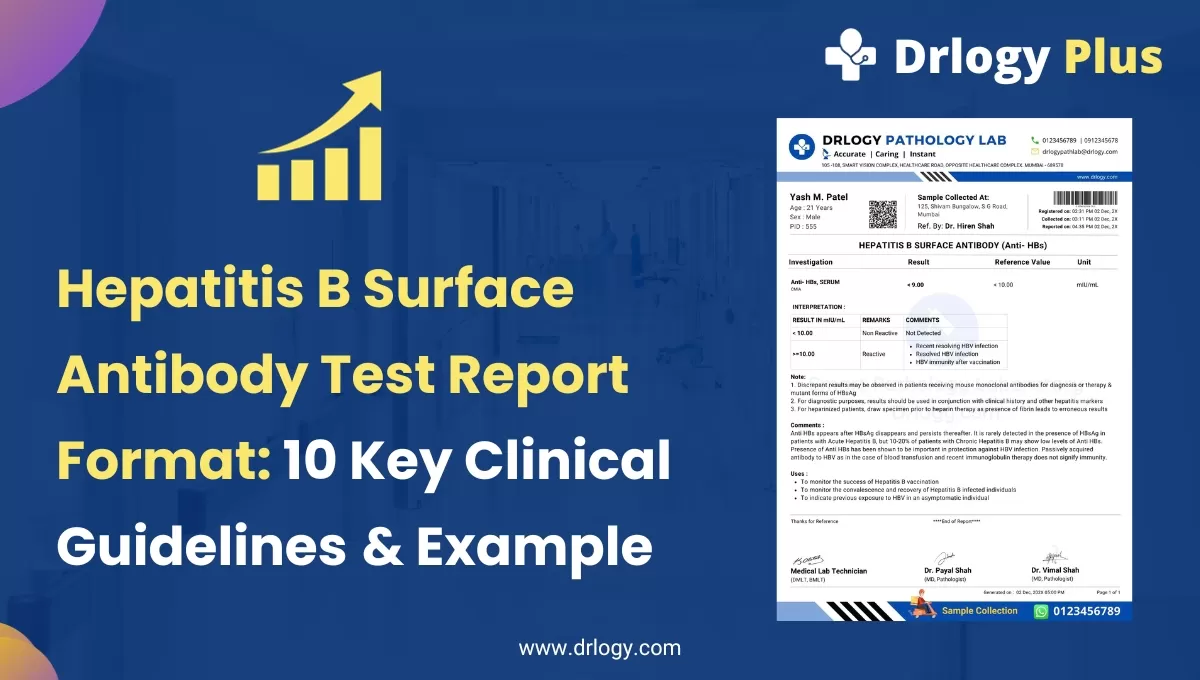
Hepatitis B Surface Antibody Test Report Format
Here is a Hepatitis B Surface Antibody test report PDF format, highlighting its significance in the pathology laboratory.
Drlogy Pathology lab software plays a pivotal in ensuring a Hepatitis B Surface Antibody Test Report Format. Additionally, Pathology lab software automates many aspects of the testing process, from sample handling to data analysis. Drlogy Pathology Software provides healthcare providers with real-time access to Anti HBS test results, enabling timely decision-making and faster patient care.
Referred
Conclusion
- The comprehensive guidelines for the Hepatitis B Surface Antibody Test underscore its pivotal in healthcare. With a focus on diagnostic precision, efficient sample handling and clear interpretation, emphasize the significance of tailored recommendations.
- From assessing immunity and vaccine efficacy to addressing cost considerations and ensuring quality assurance, the report format aligns with best practices.
- As the field evolves, the guidelines anticipate future trends, encouraging research for enhanced accuracy and global health impact assessments. In essence, these guidelines provide a structured framework for conducting and interpreting Anti HBS Test, promoting optimal patient care.